Kansas City


Each year, on the day after Thanksgiving, a crowd of 200,000 or so Kansas Citians partake in a Paris of the Plains Christmas tradition – The Plaza Lighting Ceremony. 

Kansas City’s Country Club Plaza. Named for Kansas City’s Country Club District. The Plaza. A 14-block historic shopping and entertainment district located on the southern end of Kansas City, Missouri. On the northern end of Ward Parkway.

The Plaza…with looks accentuated by fountains. By carriage rides. By statues. By sculptures. By its Spanish architecture. And at Christmastime, The Plaza takes on additional charm.

From an architectural standpoint, The Plaza’s design could be categorized as, Spanish Colonial Revival. Or, as Moorish Revival. 


Stamped upon The Plaza is a signature which speaks to Spanish architecture. The Christmas season begins in Kansas City each year in The Plaza with the illumination of this Spanish architecture. The lighting of Kansas City’s “Sevilla.” A Christmas tradition in KC, dating back to 1925. 

Although, in 1925, the “Plaza lighting” would not have been recognized as an occurrence on which a 100-year tradition would (or even could) be based.

The Plaza Lighting Ceremony. 200,000 jewel-toned lights which adorn streets on The Plaza at Christmas.

One of those Plaza buildings with Christmas lights is The Mill Creek Building. On Mill Creek Parkway.

And it is this Mill Creek Building which provides us with our story for the tradition of The Plaza lighting.

Kansas City’s Mill Creek building was the very first building ever constructed on The Plaza. 

Built in 1923, at the time of its construction, The Mill Creek Building was not known as The Mill Creek Building. No, when The Mill Creek Building was built, The Mill Creek Building was the Suydam Building.

The look for the Suydam Building was introduced to Kansas City by an architect from New York. Edward Buehler Delk. 

Edward Buehler Delk arrived in Kansas City five years before the first “Plaza lighting” took place. Delk arrived in Kansas City in 1920. Coming to Kansas City to work for a real estate developer – J.C. Nichols. 

Implementation of the style used by Edward Buehler Delk to plan out The Plaza for J. C. Nichols was attributed to trips Delk took to Spain, to Mexico and to South America. Delk absorbed architectural styles he liked in each locale, then conveyed those styles to Nichols. To be used for Nichols’ Plaza.

The look of The Plaza – and of the Suydam Building – is a look more likely to be found in southern California than in the Midwest.


Edward Buehler Delk – he whose architectural vision fostered the Suydam Building, as well as The Plaza – favored styles he took in on his trips to Spain, Mexico and South America. Styles which can be categorized as Spanish Colonial Revival. Or, Moorish Revival.

In later years, Edward Buehler Delk went on to design Kansas City buildings for Frank Lloyd Wright.

Going back to The Mill Creek Building…

Kansas City’s Mill Creek Building – The Plaza’s first building – holds a special place in Plaza lighting history. As The Mill Creek Building – the Suydam Building in 1925 – is where our tradition of “the lighting” began.

The very first “Plaza lighting” was unintentional happenstance. No grandiose planning. This which spawned a one hundred year tradition in Kansas City arose from quite a humble beginning.

In 1925 it was a maintenance worker, a maintenance worker employed by J.C. Nichols’ company – this maintenance worker, Charles Pitrat – who hung one, single strand of Christmas lights on the Suydam Building.

Hundreds of thousands partake in Kansas City’s Christmastime tradition on The Plaza. A tradition started by a maintenance worker. A maintenance worker who hung one single strand of Christmas lights on one building. The first building built in The Plaza. Designed by an architect on whose influence The Plaza is based. 

The Suydam Building. Now, the Mill Creek Building. 4634 – 4644 Mill Creek Parkway. Kansas City, Missouri. The Plaza’s first building. The first Plaza lighting.

Delk designed the building. Nichols built The Plaza. Lest we not forget when visiting The Plaza this time of year that it was a maintenance worker who hung that first stand of lights.

The prominent architect. The iconic Kansas City developer. And the maintenance worker. Our forefather for the lighting of The Plaza would be our maintenance worker, Charles Pitrat.

Kansas City


As a city, Kansas City trails only Paris with regard to each’s fountains count. The City of Fountains, as Kansas City is lovingly known to be, has over 200 fountains.

Some of those beautiful fountains in KC can be found near Kansas City’s majestic Union Station. From Union Station, take The Link over Grand Boulevard, and you arrive in the very heart of Crown Center.

At Christmastime, the beauty we find in Crown Center’s collection of fountains is accentuated by a special, special scene. Christmastime skaters.

For over fifty years Crown Center has been home to Kansas City’s original ice skating rink, Crown Center Ice Terrace. A staple for all who enjoy a Paris of the Plains Christmas.

Crown Center…

One of Kansas City’s true crown jewels would indeed be Crown Center. Another of Kansas City’s crown jewels would be the iconic corporation to which the fortunes of Crown Center Ice Terrace – as well as Crown Center itself – are owed. Hallmark. 

Each of our two Kansas City treasures – Crown Center and Hallmark – find their histories’ foundations in J.C. Hall. 

J.C. Hall…

As Kansas City continues to redevelop its downtown into one of the very finest downtowns in all of America, the wave of downtown redevelopment we see in Kansas City today also adopts into the club of downtown redevelopment leaders our forefather to Crown Center and to Hallmark, J.C. Hall.

While the focus of this article is not “redevelopment,” today’s Crown Center is very much emblematic of what can happen for a city when a corporate leader – in this case, J.C. Hall – opts to remain within a city’s downtown. Rather than follow (at that time) a trend of abandoning one’s center city roots by relocating to the suburbs.

The very beginning for Kansas City’s Crown Center goes back to a late 1960’s redevelopment plan. A redevelopment plan anchored through J.C Hall’s Crown Center businesses. A redevelopment plan which also received contributions from another iconic Kansas Citian, Walt Disney.

J.C. Hall. The one time door-to-door Avon salesman from Norfolk, Nebraska. Our Crown Center forefather.

J.C. Hall’s career evolved. From selling makeup, door-to-door. To selling postcards. And it was those postcards that J.C. Hall sold early on in his career that would bring J.C. Hall from his Cornhusker youth to Kansas City. And to forefather of Crown Center.

Yet, before we arrive at the company for which J.C. Hall’s “American signature” is forever most commonly linked, a prior step in his Kansas City business sequence

From postcards. To store. From store, to a grand department store. A grand department store in Crown Center.

Halls Department Store…

J.C. Hall began his career in Kansas City by selling his postcards. Later, adding greeting cards to his product offering. In time, J.C. Hall would go on to open that first store in Kansas City. The store from which he could sell his postcards. And his greeting cards too. This store that J.C. Hall opened in Kansas City would go on to become Halls Department Store.

Halls Department Store started out as a specialty store. With J.C. Halls offering much more of a retail collection than simply postcards and greeting cards. Yet those postcards and those greeting cards would certainly prove to be stalwarts to a J.C. Hall Crown Center icon. An icon that would go on to become a global brand. Hallmark.


At its origin, Halls Department Store stocked expensive, high-quality items. Favorites for upper echelon Kansas City patrons. In time, Halls Department Store had themselves a prime Country Club Plaza storefront.

Halls Department Store arrived in The Plaza in 1965. Later migrating from The Plaza to the hub of J.C.Hall’s enterprises. To where we find Halls Department Store today. Crown Center. 

Shoppers who visit Halls Department Store – Halls Department Store is owned by Hallmark – are heading over to Grand Boulevard. Halls Department Store. Grand Boulevard. Level 3. In Crown Center.

Crown Center, which also houses the headquarters for the centerpiece to J.C. Hall’s collection. That centerpiece, the “Crown Center nucleus” which benefitted from the experience J.C. Hall attained early on by selling his postcards? And his greeting cards? That centerpiece, is Hallmark.

J.C. Halls founded Hallmark Cards in 1910. 

Hallmark Cards has the same origin as does that of its founder, J.C. Hall. Greeting cards. Postcards.

Hallmark did not start out as Hallmark. Hallmark did not start out in Kansas City.

Hallmark Cards began in 1907 in Norfolk, Nebraska. Originally, as Norfolk Postcard Company.

The iconic Hallmark label was introduced as a stand-alone Norfolk Postcard Company brand eighteen years after J.C. Halls founded his Norfolk Postcard Company in Nebraska. Use of the Hallmark name began in 1928. 

In 1954, the original Norfolk Postcard Company – the company whose origin was the sale of those postcards in Nebraska by J.C.Hall – changed its company name. From its name at that time – Hall Brothers – to Hallmark. 

With Hallmark’s headquarters in Crown Center, with Halls Department Store in Crown Center, with J.C. Hall opting to keep his company in center city Kansas City rather than relocate to the suburbs, the underpinnings for Crown Center’s late-‘60’s redevelopment had been established. Redevelopment for Crown Center officially began in 1968. 

The beginning phase for the redevelopment of Crown Center involved construction of underground parking. As well as the central square. The central square in Crown Center, which is where we find our skaters.

Through redevelopment, Crown Center went on to become a truly unique mixed-use district. Offices. Retail. Theatres. Hotels… Crown Center opened to the public in 1971. Three years after redevelopment commenced.


Today, Crown Center encompasses 85 acres in Kansas City. Union Station. Our National World War I Museum and Memorial. Halls Department Store. Hallmark. Each, located in Crown Center.

Yet, at Christmastime, for so many, the Crown Center experience is best brought home by the ice skating. Ice skating made possible, that is, because one American corporate chief in Kansas City chose benefits bestowed upon his companies through redevelopment. Over a move out of Kansas City, to the suburbs.


So those happy skaters in Kansas City can thank a former door-to-door Avon salesman from Nebraska for their ice time fun.

They can thank J.C. Hall. Forefather of Crown Center.

Developer Financing


When it comes to financing an apartment building, banks, investors or partnerships constitute options developers may consider. So too can be the government.

The government…

Section 207 HUD loans through the 223(f) program are well-suited to finance the purchase of or the refinance of multifamily rental properties. Multifamily apartment buildings which are deemed to be in good condition. Properties that require substantial rehabilitation are not eligible for mortgage insurance (“MI”) in this program. Critical repairs must be made prior to the issuance of an endorsement.

Purpose…

The 223(f) program utilizes 35-year Government National Mortgage Association mortgages. GinnieMae mortgages…so competitive interest rates are available.


Eligible properties…

Properties must contain at least five residential units with kitchens and bathrooms which are in good condition. Furthermore, the property must have been rehabilitated at least three years prior to applying for MI. Non-critical repairs may be completed up to twelve months after closing.

Projects requiring substantial rehabilitation are not eligible for this program. An example of “substantial rehabilitation” would be the replacement of more than one major system.

The economic life for a project must be long enough for a ten-year mortgage to make sense. Amortization cannot exceed, 1) 35 years, or 2) 75% of the estimated life of improvements. The lesser of.

Here are some of the details…

87% LTV for projects with 90% (or greater) rental assistance.

85% LTV for projects that meet the definition of “affordable housing.”

83.3% LTV for market rate projects.

Participant eligibility includes for-profit and non-profit applicants.

Section 223(f) provides for Multifamily Accelerated Processing (MAP). Meaning, the sponsor works with a MAP-approved lender to obtain a firm commitment.

Files are underwritten to determine whether the project constitutes an acceptable risk. Considerations for approval include market need, as well as capabilities of the borrower.

Underwriters determine whether there will be enough project income to repay the loan, taking into account project expenses. Should the project satisfy program requirements, a commitment for MI is issued.

Applications submitted by non-MAP lenders are processed by a HUD field office through Traditional Application Processing (TAP).

With TAP, there are two processing stages: 1) the conditional commitment stage, and 2) the firm commitment stage.

The sponsor participates in a pre-application conference to determine the appraisal value of the property as well as the loan amount.

At the firm commitment stage, the loan amount is determined.

For proposals which meet program requirements, a MI commitment will be issued.

Rottweil, Germany


The history of today’s Rottweil, Germany goes back to Roman times. Its origin, finding itself in the year 73 AD. To the days of the Roman Empire. To days when Romans governed the region we know today to be Rottweil, Germany. In Roman times, Rottweil had been known as Arae Flaviae. 


In German, Rott means, a settlement located on a steep bank. In German, Rott means, a clearing. In knowing the meaning of Rott, Rottweil – nestled between the Alps and the Black Forest…containing our prefix, Rott – is aptly named.

What today we know to be Rottweil possesses a history which goes back to Roman times. Our prefix of Rott, derived from Old High German.

Old High German was the earliest stage of the German language. The common language in the region from 500 AD to 750 AD.

Today, Rottweil is a German town with a population of 25,000. Rottweil is part of the German state of Baden-Württemberg.

The very beginning for Rottweil dates back to 75 AD. In 75 AD, this settlement which later would go on the become Rottweil took hold long, long before Germany became a country. This settlement began long, long before 26 then-independent Prussian states joined together to form Germany. The very beginning for Rottweil goes back to long, long before there even was a Kingdom of Germany.


Rottweil, Germany.

In 1871, the town of Rottweil officially became part of the German Empire. Rottweil is one of Germany’s original towns.

Rottweil became a German town when Wurttemberg joined a newly-forming German nation. This happened in 1871.

Up through 1871, Rottweil had been part of the independent Prussian state, Wurttemberg. Wurttemberg was among the Prussian states that united to create Germany.

Eighty one years after Wurttemberg joined the German Empire – bringing Rottweil along with it – Rottweil became a Baden-Wurtemberg town. A status Rottweil holds to this day.

Rottweil is a German town. Rottweil is also a German district. 

While 25,000 Germans live in the town of Rottweil, 150,000 Germans live in the district of Rottweil.

A town and a district. Rottweil too is the source for which one of the world’s favored dog breeds is named. The Rottweiler.

In Germany, the Rottweiler was originally known as Rottweiler Metzgerhund. In German, Rottweiler Metzgerhund means, Rottweil butcher’s dog.


During the 19th Century, Rottweilers were used by butchers in Germany in the transportation of a butchers’ meat. Rottweiler, “the Butcher’s Dog.”

Aside from being a butcher’s helper, the Rottweiler’s job during Roman times – a job the Rottweiler held throughout the 19th Century in Germany – was to herd and protect livestock.

Cattle-herding extraordinaire. Pulling butchers’ carts to market. The Rottweiler.

Accompanying a butcher when the butcher went to market, on their way back home from the market, a butcher would tie a belt – with his money in the belt – around the neck of his Rottweiler. For safe keeping. 

Rottweil’s most famous contribution -“the Butcher’s Dog” – has a long and storied history.


And Rottweiler history goes way, way, way back. To long before there ever was a Germany. Rottweiler history goes all the way back to the Roman Empire. To a time when Rottweilers traveled alongside Roman soldiers. 

In those early days of Rottweiler history, in days when Romans – not Germans – lived in what one day would go on to become Rottweil, Rottweilers trekked the Alps with Romans.

As Rottweilers later did in Germany, during Roman times, Rottweilers herded and drove cattle. For Roman armies.


Roman armies were mobile. Traveling from region to region within the Roman Empire. As roaming armies, cattle was a primary food source for Roman soldiers. Driving and protecting cattle was the job of the Rottweiler. 

Rottweilers led and protected this vital food source for Romans. Protecting Roman cattle from countryside predators. Predators who would, should they be left unintimidated, thin a herd. A thinned-out herd would lead to a reduced food supply for Roman legions.

The Rottweiler. Roman ally. Butcher’s helper. Protector. Herder. Companion.

Rottweilers protected cattle in Roman times. Rottweilers protected cattle during the days of the Kingdom of Germany. Rottweilers protected cattle during the days of the German Empire. Rottweilers protected cattle in Germany, after Germany became a country in 1871. 

Rottweiler. “The Butcher’s Dog.” Family companion in so many American homes. Including, in my own home. 

Blairstown, New Jersey


Located in rustic Warren County, New Jersey, situated alongside the Paulins Kill River, nestled at the foothill of Mount Tammany, we find our storybook-of-a-township. With a resident count of just under 6,000. This quaint Warren County community, aptly named for its good son, John. Blairstown.

John, the 19th Century industrialist. John, the railroad man. John, the philanthropist. This township, nationally reknowned for its bad son, Jason, was built upon successes attained by its good son, John.

Jason, the other son. The bad son. The very bad son.

Jason, a famous Hollywood creation. The star of a slasher series. Jason Voorhees. Circa the original 1980 film, Friday the 13th. This, the very bad son of Blairstown. The bad son of Blairstown who demonstrated oh-so-horrific tendencies.

This town, where, on any given Friday, when that Friday falls on the 13th of the month, you can get your very own painted-on horror face. You can get your very own painted-on machete wounds. Your horror face and your machete wounds, compliments of Zella Bella’s Gaggle of Giggles. At the museum. A Blairstown gala, inspired by the bad son.

In this town, you can even have your own Friday the 13th-themed wedding. A wedding, held on the 13th of a month when that 13th of the month lands on a Friday. A Friday the 13th wedding. A ceremony, inspired by the bad son.

The local brews here? Try Slasher Stout and Camp Crystal Lake Water. Adult beverages, again, inspired by that very bad son. Beverages poured at Buck Hill Brewery and Restaurant. On Route 94. In Blairstown.


On a Friday in Blairstown, when that Friday lands on the 13th of the month, you’ll find costume contests. Costume contests held at the township museum. On Main Street. In Blairstown.

Or, maybe catch a screening of the original Friday the 13th movie at Roy’s Hall on Main Street.

In the original Friday the 13th movie, you will see our Camp Crystal Lake counselor and cook – this character being, Annie – walking down Main Street in Blairstown. Walking right by Roy’s Hall. Annie is the first Friday the 13th victim. Killed by Mrs. Voorhees. That awful mother of the bad son.

And when you are visiting Blairstown, you just have to grab a bite to eat at the diner you see in the opening scenes of the original Friday the 13th – the Blairstown Diner.


When visiting Blairstown Diner, I strongly recommend adding their famous Death By Jason hot sauce on top of your eggs over easy!

Blairstown, New Jersey…

While Blairstown has indeed become every horror movie fan’s must-visit scene…its vibe-of-horror inspired by terrible behavior espoused, first, by a vengeful mother, then later, by her relentlessly evil son, Jadon, this charming town’s most important character isn’t Mrs. Voorhees. Nor is this town’s most important character Mrs. Voorhees’ son, Jason. 

Rather, whereas Blairstown’s infamous son – I.e.: the bad son – is indeed Jason, Blairstown’s good son, would be John. 

The good son…

The good son of Blairstown was an industrialist. Not a Hollywood killing machine. The good son of Blairstown was a railroad man. Not a slasher. 

John Insley Blair. The good son of Blairstown. Our namesake for the township.

Blairstown, once Gravel Hill, once Smith’s Mill was incorporated in 1845. Renamed for its good son six years prior to the township’s incorporation. Named for John Insley Blair. In 1839. A township renaming undertaken to pay homage to the good son of Blairstown, John Insley Blair. 

Johm Insley Blair, a very wealthy man. In fact, correlating late-19th century net worth, in relative terms, to 2025 dollars, to this day, John Insley Blair still ranks as the wealthiest New Jerseyan. The wealthiest New Jerseyan, all time. 

At the core of Blairstown’s good son’s immense wealth you’ll find railroads. You will also find a tale of the good son’s acquisition of property from the United States government.

This good son, John Insley Blair, acquired nearly two million acres of land from the United States government. Acreage, on which, the good son proceeded to lay tracks for his Blairstown Railway.

And John Insley Blair’s railroad holdings did not begin and end with his regional home-based Blairstown Railway. 


John Insley Blair, together with his partners, owned Delaware, Lackawanna and Western Railroad. As well as Union Pacific Railroad.

Atop the railroads he owned, John Insley Blair also held executive positions in numerous additional railroads. At one time, serving as president for sixteen railroads. While personally owning the most rail mileage in the world.

Blair, Wisconsin is named after the good son, John Insley Blair. The township naming of Blair, Wisconsin, attributed to John Insley Blair’s holdings of Green Bay and Minnesota Railroad stock. 

Blair, Nebraska is also named after John Insley Blair. With Blair, Nebraska, once again, we find a link to the railroad.

John Insley Blair acquired 1,000 acres of land in Nebraska. John Insley Blair’s Nebraska acreage having been located in a section of the Cornhusker State that would go on to become Blair, Nebraska. 


John Insley Blair’s Nebraska land acquisition took place once Sioux City and Pacific Railroad announced an extension of their rail line into Nebraska. The location of Sioux City and Pacific Railroad’s expansion over the Missouri River and into Nebraska? That 1,000-acre Nebraska land purchase by John Insley Blair. 

Yet a railroad magnate, John Insley Blair had not only been.

Blairstown’s good son’s vision had also been cast upon cultivating new towns which could one day come to be alongside those train tracks Blair had laid. John Insley Blair’s railroad, in time leading to the development of nearly 100 trackside towns.

One of those trackside towns being, John Insley Blair’s hometown of Blairstown. This, the hometown of the good son, John. And this too, the hometown of the not-so-good son, Jason.

The very bad son…

The story of Friday the 13thI.e.: the entrance of Blairstown’s very bad son into American culture – was written by Victor Miller. The original 1980 Friday the 13th film was produced by Sean Cunningham.

Miller’s original horror story was not titled Friday the 13th. Miller’s original title for his story-of-terror, a story which went on to feature the bad son Jason, had been titled, A Long Night At Camp Blood. It was the movie’s producer Sean Cunningham, who, during production, went with the changed, now-iconic title, Friday the 13th.

Interestingly, the appearance of bad son Jason in the 1980 film was not written into the original story by Miller. This idea for a villain who would go on to become the bad son of the series…this idea, for Jason to make his short cameo in the 1980 film, came about by way of a suggestion made to Cunningham by a makeup artist. 

Jason, ascending from his aquatic slumber at the bottom of Crystal Lake, rising to vanquish the movie’s main character, Alice, during Alice’s dream. This sequence was actually an unplanned, late-phase movie add-on. Jason’s cameo in the 1980 film, never having been written into the original story by Miller.


The good son, and the bad son…

We know John Insley Blair to be Blairstown’s good son. And we know Jason Voorhees to be Blairstown’s bad son. Yet, by following Miller’s original storyline, Jason Voorhees would never have ended up becoming Blairstown’s bad son.

Inspired by the shock value thrill moviegoers witnessed in theatres while watching the 1976 film Carrie – as the hand rose up from the grave at the end of Carrie – it was a makeup artist’s ad-hoc, onset idea to create a parallel Carrie-like shocker for Friday the 13th. Culminating in, Jason rising up from the depths of Crystal Lake.

This scene, directly inspired by Carrie’s mother’s hand rising from that grave in Carrie. And with this added scene to Friday the 13th, what Miller had written into his original work – Jason, as a boy who drowned – was forever altered.

Jason, the boy who originally falls victim to a sad tragedy – his drowning in Crystal Lake – becomes the series killer. The series killer for the next 40-plus years.

In Victor Miller’s A Long Night At Camp Blood, Jason Voorhees is a victim. Never a killer.

Victor Miller never wrote Jason into his story – his story, which in turn, spawned the series –  as a killer of any sorts. Victor Miller never created his Jason character to be evil.

So, while Blairstown is famous for the township’s good son, John, and for the township’s bad son, Jason, by following the original storyline in that which started it all for Friday the 13thA Long Night At Camp Blood – there would have never been the existence of this bad son of Blairstown, Jason.

By following Miller’s original storyline, we would have the good son, John, and an unfortunate son, Jason. A tragedy.

Be it not for a creative, off-script, last minute idea introduced to Friday the 13th’s producer by a makeup artist, America would then not have had Blairstown’s hockey goalie-looking slasher. Then, if so, Blairstown would have had its good son, John, and its tragic son, Jason.

No hockey mask. Just the sad drowning of a young boy at a campground during the summer months. This drowning, then spurring on the subsequent killing spree enacted by the boy’s mother.

The original Friday the 13th killer – and, according to the story’s writer, the ONLY A Long Night At Camp Blood – Friday the 13th killer – Mrs. Voorhees.

Kansas City’s American Royal


In 1899 there was a cattle show which took place in Kansas City. At Kansas City Stockyards. Eight years later, a horse show was added to this Kansas City venue.

The cattle show. The horse show. We have our foundation for Kansas City’s American Royal.


Horse shows. And Rodeos. Lest us not forget the barbecue World Series.

Kansas City’s World Series of Barbecue is the largest such barbecue competition in the world. Needless to say, the Barbecue Hall of Fame is located in Kansas City. At American Royal. 


The World Series of Barbecue is a weekend-long November event which includes venues such as The Backyard Barbecue and Steak Cook Off and the World Series of Barbecue Sauce Contest. 

Barbecue and Kansas City. An American “marriage,” akin to that of peanut butter and jelly. That cattle show – held in 1899 -started it all off. 

With regard to American Royal cattle exhibits, these began as the National Hereford Show.

The National Hereford Show provided an opportunity for ranchers to show of their purebred cattle. This exhibit…then followed by the sale of cattle to buyers.

The rodeo, American Royal-style…

For the past 75 years, when the spring rolls around, American Royal plays host to ProRodeo…and there is much to take in at a KC rodeo.

The American Royal bull riding competition…

With bull riding competition, a rider needs to remain on the bull for a minimum of eight seconds. Each bull ride is judged. There is a point system. As well as a final score. The rider’s score…determined by judges. 

Bull riding scoring ranges from a low score of 1 point, to a 100-point maximum.

Bull riding scoring is based upon ride difficulty – I.e.: how difficult the bucking bull is to ride – coupled to the level of control a rider demonstrates.

Bull riding…here is where we find rodeo clowns.


Rodeo clowns – known as “bullfighters – are there to distract the bull once the rider is jettisoned. Oh, the rider will likely be jettisoned. Ideally, after an eight second ride. 

Bulls tend to be aggressive. Bulls are also highly unpredictable. Rodeo clowns are there to function as a distraction to the bull. A precaution. To protect the rider.

Bareback riding in KC at American Royal…


Bareback riding is horseback riding. Bareback riding is accompanied by quite a formidable challenge: the bucking horse.

A bucking horse…onto which the rider needs to hang on. Hang on, that is, for just as long as a bull rider needs to hang on: eight seconds

Each bareback ride is judged. Judged, taking into account how difficult the horse was to ride. Coupled to the level of control the rider demonstrates.

Bareback riding at American Royal is a competition. Each bareback ride is judged. As is the case for American Royal’s bull riding competition, bareback riding scoring ranges from 1 to 100 points. 

American Royal steer roping…


Steer roping is a timed event. With steer roping, the cowboy, atop his horse, must lasso a Corriente steer. Once the steer is lassoed, the cowboy ties his rope to his saddle. 


With his steer lassoed, then tied to the cowboy’s saddle…the dismount.

Steer roping competition is all about timing. Steer roping is about, how long it takes the cowboy to tie three of the steer’s legs together. The fastest time wins.

Revisiting the World Series…

Harrisburg, Pennsylvania’s Chunky BBQ is the reigning World Series champion of barbecue.

Each year, with its array of events, American Royal plays host to just about half-a-million attendees. While KC’s BBQ World Series draws in excess of 60,000 to this fabled cookout-for-champions.

Pemberton


The naming of Burlington County, New Jersey’s Pemberton goes back to late-17th times. In naming of a town, we find a link William Penn. To a prominent local mill. To a a successor to Benjamin Franklin. To an abolitionist. One who decried waging war on Indian tribes. 


The beginnings for the Pemberton’s…


In 1682, an Englishman by the name of Phineas Pemberton settled on 300-some acres along the Delaware River. Phineas Pemberton, arriving as a colonial settler in England’s new American colony of Pennsylvania. Arriving in Pennsylvania by way of Lancashire, England. Phineas Pemberton started his colonial journey in Maryland. Later, migrating north. To Pennsylvania.

Once settled in Pennsylvania, Phineas Pemberton proceeded to work closely with Pennsylvania’s founder, William Penn. Phineas Pemberton served as Chief Administrator of Buck’s County, Pennsylvania for William Penn. Across the Delaware River from where today we find Pemberton, New Jersey.

Phineas Pemberton’s arrival in Pennsylvania’s Buck’s County came one year after King Charles II granted an area of land across “the Pond” within the British Empire to William Penn. Or, to be more era-precise, to Sir William Penn. This land, granted to Sir William Penn as a debt payoff by England’s king. This had been money owed by England’s king to William Penn’s father.

Pennsylvania’s very beginning. On land which had once been – prior to falling under Britain’s rule – New Sweden. New Pennsylvania settlements were taking hold. This, a time of colonial settled. And colonial migration. Leading to population growth for the new Buck’s County. 

Hence, we have our framework for an entrance by the Pemberton family name into the annals of American history.

In Buck’s County’s, Phineas Pemberton became William Penn’s Chief Administrator. As William Penn’s Chief Administrator, Phineas Pemberton was responsible for record keeping pertaining to the arrival of new settlers in Buck’s County.

Phineas Pemberton became Clerk of all Courts for Buck’s County. Phineas Pemberton became Register of Wills for Buck’s County. Phineas Pemberton became Master of the Rolls for Buck’s County. Phineas Pemberton became Receiver of Proprietary Quit Rents for Buck’s County. Phineas Pemberton became Surveyor General for Buck’s County. Phineas Pemberton’s was, shall we say, quite an important man.

Be it calculations of Buck’s County cattle. Be it births in Buck’s County. Buck’s County deaths. Migration tabulations for new settlers arriving in Buck’s County. These records were being memorialized by William Penn’s Chief Administrator, Phineas Pemberton.

Phineas Pemberton…establishing groundwork in Pennsylvania for a Pemberton family member who would later go on to become Pemberton’s namesake.

It would be some fifty years after Phineas Pemberton’s record keeping exercises for William Penn that we’ll find our origin for what would go on to become the New Jersey community for which the Pemberton family name today remains affixed.

As we will find when we learn about the beginnings for so many American cities and towns, industry was at the forefront of the progression of this community towards a becoming, first, a borough. Then later, a township. And in Pemberton’s case, that American industry happened to a mill. A saw and grist mill.

In 1752, David Budd, together with a group of entrepreneurs, established New Mills Company. Recognizing how Pemberton’s access to a great natural waterway could provide power to his mills, David Budd built his first industrial mill twelve years prior to the founding of his New Mills Conpany.

Upon building his first area mill in 1740, David Budd’s New Mills Company proceeded to build additional mills. These were saw and grist mills.

David Budd’s original New Mills Company mill stood in a community which would later go on to adopt the name, for which, David Budd’s company provided the reasoning. The community became, New Mills.

Yet, New Mills at this time was not a township. Nor was New Mills yet a borough. At that time, part of this New Mills community was situated within New Hanover. While another part of this New Mills community was situated within Northampton. Northampton, today’s Mount Holly.

Nonetheless, what was then New Mills was very much a burgeoning community. Growing around David Budd’s saw and grist mills. Across the Delaware River from where Phineas Pemberton earlier served as William Penn’s record keeper.

As the 18th Century faded, becoming the 19th Century, this mill community of New Mills would go on to adopt its new name: Pemberton.

These old sections of New Hanover and Northampton, together making up New Mills, broke off from their respective townships. They broke off to form a new borough. This township break-off is where we find the origin for the borough of Pemberton.

The borough of Pemberton – this, which once had been known as New Mills – was incorporated as a New Jersey borough in March of 1826. Pemberton was later incorporated as a New Jersey township. That happened twenty years later. In 1846.

We have Phineas Pemberton, William Penn’s numbers cruncher. We have New Mills Company. And David Budd. We have our township name, Pemberton.

While Phineas Pemberton and David Budd were locals of great importance to this region within New Jersey’s Burlington County, neither of these two men ended up becoming the reason for why Pemberton today goes by the name of Pemberton.

Pemberton is really Pemberton due to values espoused by an abolitionist from Pennsylvania. James Pemberton 


James Pemberton. The Pennsylvania Quaker who succeeded Benjamin Franklin as President of the Pennsylvania Abolition Society.

The New Mills borough renaming which took place in 1826 – from New Mills, to Pemberton – was an undertaking to honor that successor to Benjamin Franklin. He who headed up Franklin’s anti-slavery organization, after Franklin’s departure. An anti-slavery movement in Pennsylvania which was led by the Pennsylvania Abolition Society. Carried onward by James Pemberton. So as to ensure that the institution of slavery would not become one pillar on which this new country of America would be built.

James Pemberton. A founder of Pennsylvania Hospital. President of Benjamin Franklin’s Abolition Society. Influential area landowner. Member of the Pennsylvania Assembly…resigning from the Pennsylvania Assembly due to the fact that the governor of his State declared war on Indian tribes. Phineas Pemberton’s grandson.

James Pemberton. Our namesake for Pemberton.

Emporia, Kansas


In east central Kansas, at the junction of the Cottonwood River and the Neosho River, you’ll find the foothills of the Flint Hills. Emporia, Kansas. The very beginning for Emporia…a $1,800 land purchase.

This original land purchase encompassed an area within Emporia which stretches from what today is Emporia’s 6th Street to 18th Avenue. Due northwest, of this article’s topic.

Founded in 1857 as a trading post along the Santa Fe Trail, one can hypothecate that “DNA” for the Emporia one sees today took hold during the 1960’s. 

In 1969, the Tyson plant in Emporia opened. Opening after a two-year period of thorough plant modernization, and expansion. That Emporia Tyson plant which opened in 1969 was not yet Tyson. This plant, at that time, had been IBP – Iowa Beef Processing. 

The decade of the ‘60’s brought with it notable innovation in the American beef business. Leading to increases in investment in America’s beef industry. Which significantly reshaped the economy for the Great Plains. In which, Emporia resides. 

IBP’s plant in Emporia opened in 1969. And it was the sale of this plant to IBP two years prior to the plant’s opening – the sale of the plant to IBP taking place in 1967 – which foretold of innovation in America’s beef processing industry.

In 1967 Armour and Company sold their Emporia-based beef processing operation to IBP. IBP’s plant modernization – completed two years later – was emblematic of this decade of innovation.

Emporia is nestled within the Great Plains along I-35. Between Wichita and Kansas City. For this piece, I’d like to cite one unique 19th Century paradigm which, one can argue, led to Emporia’s evolution as a beef processing hub. And then, so too, to the emergence of major Midwest beef processing centers situated throughout the Midwest.


One hundred years prior to the sale of that Armour and Company Emporia plant to IBP, the British Empire made up just about one quarter of the world’s GDP. In the 1860’s, a severe plague broke out in Great Britain. Curtailing Britain’s domestic beef industry. Reducing the total number of heads of cattle which could be brought to market within the British Empire.

While over half of all revenues in 1860 for the British Empire flowed to London through Great Britain’s expansive “outposts,” those living on the British Isles themselves back home loved their beef.


England. Scotland. Wales. Ireland. As well as thousands of smaller islands. The British Isles. Enter a beef shortage. Coupled to, no let-up in the demand for beef within Great Britain. 

As this epidemic ravaged Great Britain, domestically raised cattle – cattle which could have been brought to market in Great Britain – took a hit. Less cattle. Less cattle going to market in Great Britain. The beef shortage.

At this same time, across The Pond in the United States, the Great Plains was opening up to commercial interests.

Great Britain recognized this confluence of events: a) a beef shortage in Great Britain, plus b) the opening up of thousands of acres of prime cattle-grazing land in the United States.


With the beef shortage taking hold in the world’s largest economy, the price of beef shot up. Elevated beef prices lead to investment opportunities. Then. And now.

Prior to an increase in beef prices, American businessmen were already deploying capital to develop the United States cattle industry. Deployed capital which led to modernization for, and the growth of, American cattle business on the Great Plains. Enter additional capital. From London.


Increased demand. Higher prices. Investment. The build-out of the cattle industry on the Great Plains. Yet still, in 1860, transportation lines for Midwest cattle had yet to be modernized. Inhibiting efficiency for the market.

While grazing land in the Great Plains further opened up to American ranchers, a notable degree of capital was flowing to the Plains from across The Pond. Coming from British financiers. This capital infusion fueled the growth of – as well as modernization for – the American cattle industry. As investments made by Great Britain to facilitate the transportation of cattle led to investment in railroads, the very means by which the shipment of cattle took place incurred new efficiency.

While buyers of beef were (and are) concentrated in urban centers – and for Great Britain, across The Pond – United States stockyards were (and are) located in America’s Midwest. So too, is Emporia.

Investment in railroads – by the United States government, and by British financiers – connected urban centers – I.e.: buyers of beef – to beef supply – I.e.: stockyards. In fact, many early stockyards evolved through partnerships struck between railroads and the cattle industry itself.

Timing…

Emporia was founded in 1857. Thirteen years later, in 1870, Emporia was incorporated.

Emporia was founded not long before the aforementioned bout of anthrax gripped the domestic British cattle industry. Leading to…Britain’s shortage of beef.

This beef shortage checked the world’s largest economy. Driving down the number of heads of cattle which came to market in Great Britain. While at the same time, driving up the price of beef. As demand for beef remained constant.

The curtailing of production of domestic beef in Great Britain – the anthrax – coincided with the opening up of the Great Plains to ranchers in the United States. Fueling investment. Leading to improvements made in the transportation of cattle by rail. Leading to the prioritization of investments in railroads. And in beef processing centers. 

By 1870, two railroads reached Emporia. The Atchison, Topeka and Santa Fe Railway. And the Union Pacific Railway. Emporia became a booming railroad hub. As well as a cattle industry center, at that.

Railroads’ have unique American relationship to our cattle industry. And to Emporia.

Driving through Emporia today, one can’t help but recognize our correlative railroad-to-cattle industry linkage.


Cattle sales are held in Emporia every Wednesday. Held at Emporia Livestock Sales on Albert Street.


The Emporia Livestock Sales building is nearby train tracks. Tracks which are owned by BNSF. These BNSF train tracks in Emporia enable freight to be transported from California to Chicago.


Standing in front of the Emporia Livestock Sales building, looking to the south, you’ll see the Tyson plant.

That old Tyson plant in Emporia – where my aunt Rita worked for over 30 years – is, just like the Emporia Livestock Sales Building, located alongside Emporia’s BNSF train tracks. BNSF’s Southern Transcon line. 

This Midwest connection of stockyards to urban centers. The railroad and the cattle industry…

Stand atop the Prairie Street Bridge in Emporia. Look down. BNSF’s Transcon tracks. Look to the north. Emporia Livestock Sales. Look to the west. The former Armour plant. Which became the IBP plant. Which then became the Tyson plant…where Aunt Rita worked for over 30 years.


We can attribute this Emporia story to the opening of the Great Plains to ranchers. Yet there was also was that epidemic in Great Britain to think about.

As such, Great Britain, some may argue, is an unseen hand, contributing to the history for Midwest beef processing plants. Beginning in 1860’s.

Then, so too, Great Britain would be a catslyst, an oft overlooked forefather, one may say, which added their own special contributions…collectively making up Emporia’s unique and rich American story.

Holmdel Township in the very beginning…


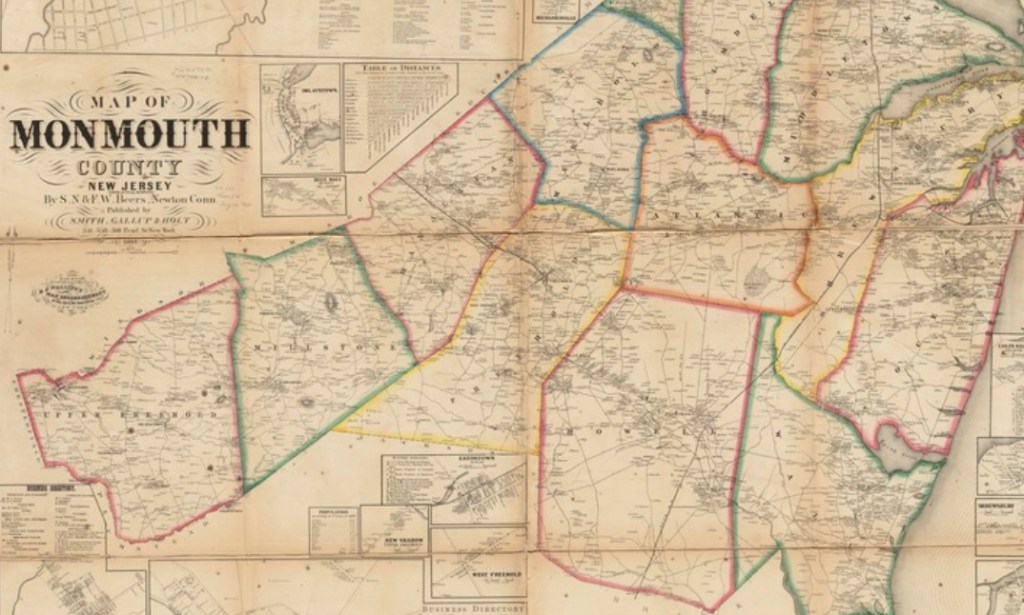
What one could say was the dawn for New Jersey’s Holmdel Township finds its beginning verse in the Monmouth Patent.

The onset for Holmdel Township started off with the annexation by Great Britain of territory formerly possessed by the Dutch.


This territory – that which had once been the Netherlands’ New Amsterdam – was put under the control of Great Britain’s Royal Crown. As such, the Monmouth Patent enabled conveyances of land to settlers by Great Britain in this new British territory.

In April of 1665, Great Britain’s deputy-governor for New Amsterdam granted “patents” for a triangular parcel of land located in today’s Monmouth County. This was the Monmouth Patent. This, the tract of land in Great Britain’s New Amsterdam territory which would later become New Jersey’s Monmouth County.


The earliest families to acquire land through the Monmouth Patent in what today we recognize as Holmdel Township had been the Bowne family, the Holmes family, the Cotterell family and the Stout family.

The Holmes family’s tract of land stretched north of Ramanessin Brook to Hop Brook Farm – the Holmes Tract.

John Bowne’s tract of land touched the northernmost boundary of the Monmouth Patent “triangle.”

Eliezer Cotterell received two land conveyances. Cotterell’s first conveyance totaled 100 acres. Cotterell’s second conveyance totaled 130 acres.

Richard Stout acquired a tract of land within the “triangle” which was situated to the east of Ramanessin Brook – the Richard Stout, Senior Tract.

One other such early land conveyance through the Monmouth Patent was the Bray Tract. This, the conveyance of land to a Baptist minister. John Bray.

Fifty acres was the Bray Tract…running from the easternmost portion of the Monmouth Patent “triangle” – at Bray’s Brook – to the east side of Hop Book Farms. 

And it was this 1687 purchase of territory by John Bray which led to the establishment of the first Baptist church in the State of New Jersey. Which was rather symbolically supportive of the Monmouth Patent “exercise” in the first place. As the Monmouth Patent codified religious freedom in this new British territory of New Amsterdam.

New Jersey’s first Baptist church evolved from this Bray Tract. In time, becoming Middletown Baptist Church. A church located in today what we know to be, Holmdel Township. As Baptists throughout New Jersey can point to their New Jersey origin as being, the Bay Tract.

On land John Bray acquired through the Monmouth Patent, John Bray proceeded to set up Bray’s Meeting House. 

Bray’s Meeting House became a congregation for Baptists. Local Baptists whose house of worship became…Bray’s Meeting House. At the corner what today would be Main Street and Holmdel Road. In Holmdel Township.


As the number of Baptists who resided within and near this new British territory of New Amsterdam in today what we call “Holmdel” grew, in 1709 John Bray donated a portion of his land to the Baptist Church. This land donation by John Bray led to New Jersey’s first Baptist church. This first Baptist church in New Jersey was, at first, known as The Upper Meeting House


With The Upper Meeting House established, during the first half of the 18th Century, this farming community of what one day would one become Holmdel Township experienced an increase in the migration of Baptists to the area.

First, at John Bray’s Meeting House, then later, at what would become The Upper Meeting House, Baptists weren’t yet meeting in Holmdel Township. Where Holmdel Road meets Main Street, as Baptists joined together, this was not yet Holmdel Township. At that time, Baptists were meeting in Middletown. There was not yet a “Holmdel.”

What had been Middletown then consisted of all of the territory in Monmouth County north of the Navesink River. And east of today’s Freehold Township. So for nearly 150 years, The Upper Meeting House – at the corner of Main Street and Holmdel Road – was located in Middletown.

In 1848, the expansiveness of what was then Middletown was altered. Middletown was broken up. And parceled out. 


In 1848, Raritan Township was spun off from Middletown. This new Raritan Township consisted of what later would become Hazlet, Aberdeen, Union Beach, Keansburg, Keyport, and Matawan. As well as…Holmdel.

Nine years after Middletown was restructured, in 1857, Holmdel Township officially formed. Formed, through an act of the New Jersey Legislature. 

John Bray originally settled in today’s Holmdel Township in 1684. Three years later, John Bray received his 50 acres. Granted to Bray by New Amsterdam’s acting governor.

The earliest land conveyances made possible through the Monmouth Patent were not enacted through the acts of a full-fledged territory governor. 

In 1664, the British territory made up of what would one day become New Jersey – then, being, New Amsterdam – was governed by a British deputy governor. This British deputy governor in 1664 was Richard Nicolls.


A few years after settling in Monmouth County, John Bray increased his land holdings. Bray purchased two additional tracts of land. These purchases took place in 1688.

The first of John Bray’s subsequent land purchases totaled 130 acres. Bray’s second land purchase in 1688 totaled 30 acres.

Johm Bray’s land holdings – the land grant he received from Deputy Governor Richard Nicolls, coupled to his subsequent land purchases – foretold of the pathway to Bray’s later establishment of his Meeting House. While also foretelling of Bray’s later land donation. To the Baptist church. Leading to, New Jersey’s first Baptist church.

On the corner of Main Street and Holmdel Road.