Today in Kansas City’s City Market, on weekends, one will find global eateries, gourmet grocery stores, indie boutiques and the Arabia Steamboat. In the 1970’s, the mob ran City Market. While unknowingly also functioning as an idea for Hollywood.
Martin Scorsese’s Casino was released in 1995.
Nick Civella, the character upon whom Casino’s Vincent Borelli had been based, was the then-boss of the Kansas City mob.
In Casino, the Artie Piscano character was based upon Kansas City mobster Carl “Tuffy” DeLuna.
Tuffy DeLuna – born in Brooklyn – was once an underboss in the mob in Kansas City. In Casino, the DeLuna-inspired character dies of a heart attack when the FBI raids his home.
DeLuna’s house was indeed raided by the FBI. In 1979. However, DeLuna did not die of a heart attack during that raid. In real life, DeLuna was sentenced to twenty years in prison. DeLuna was released from prison in 1998.
Prior to the outbreak of the Civil War, an abolitionist movement in the new territory of Kansas was led by “jayhawkers.”
Jayhawkers were settlers who moved west…into this new territory of Kansas. Jayhawkers possessed an ideology which was predicated upon the admission of the new territory of Kansas into the union as a free state. The acknowledged territorial capital of this new Kansas territory – at that time – was Lecompton. Yet jayhawkers – i.e.: abolitionists – established their own unofficial territory capital – and their own unofficial legislature – in Topeka.
Two capitals, two legislatures, in two different cities….one territory.
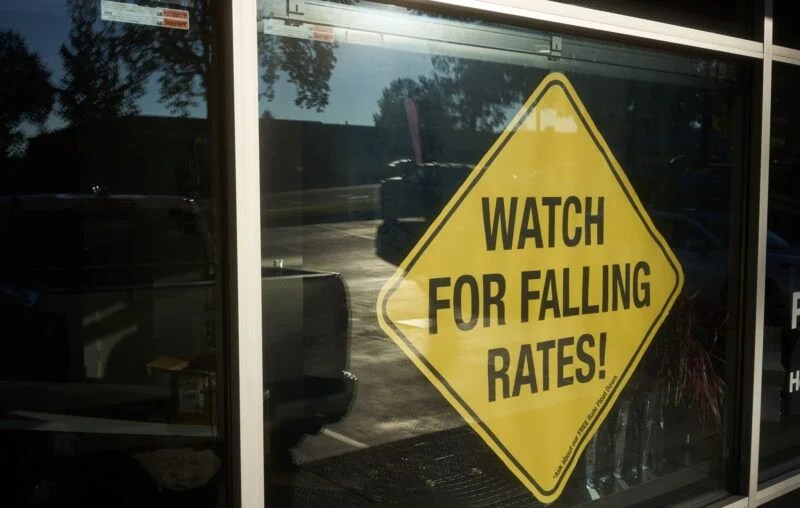
Over the past few years, yields on 10-year Treasuries rose. So too did mortgage rates. Those higher yields…benefitting investors who purchased Treasury bonds. By way of higher earned interest income. Yet these higher bond yields functioned as a “tax” on home buyers. Driving up the cost of homeownership. Due to higher mortgage rates. Due to higher monthly mortgage payments. Arguably, having the same effect as a “consumer tax” placed upon homeownership.
Remember, during this recent environment of increased – and increasing – bond yields, coupled to elevated mortgage rates, home prices rose. Home prices did not go down. Housing inflation got worse: 1) higher home prices, and 2) higher interest rates.
As monthly mortgage payments rose for home buyers as a result of higher mortgage rates (coupled to increasing home prices), what simultaneously so too did rise were earned income opportunities for bondholders. Bondholders benefitted…at the expense of home buyers.
If the Fed does indeed enact two rate cuts through the end of 2024, mortgage rates are likely to drop. As too will yields bondholders attain, through their purchase of newly-issued 10-year Treasuries.
A trade-off is in the making. A much-welcomed rebalancing.
In 1908, National Real Estate Exchanges were established.
During the first decade of the 20th Century, National Real Estate Exchanges set out to figure out good ways to facilitate effective “cooperation.” Cooperation which would benefit real estate brokerages by facilitating the buying and the selling of real estate. In summary, these were the earliest days of what we today refer to as cooperation among REALTORS.
Early National Real Estate Exchanges established communication channels for members to convey the benefits of – and the features for – properties which were available through members of the Exchanges. Available to the buying public, that is, only through centralized cooperation of Exchange members.
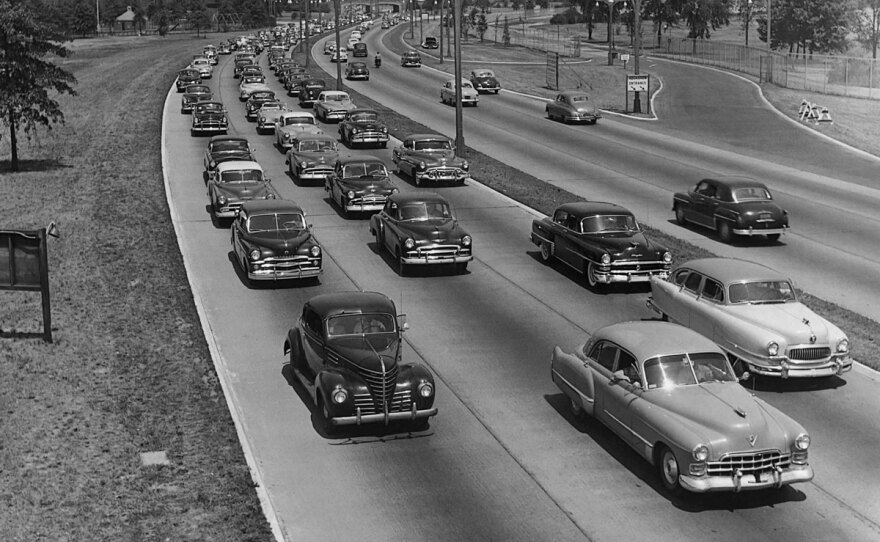
The Federal-Aid Highway Act of 1956 – commonly known as the National Interstate and Defense Highways Act – triggered the construction of countless highways throughout the United States. Those newly-constructed highways were then able to take Americans from their offices in American cities to the suburbs.
The suburbs…where there is just less density. Paving the way – literally, and figuratively – for suburban housing demand. Coupled to the building of suburban homes. Those were (and are) larger homes. Larger than homes that could be built in the denser American cities.
Ten years – 41,000 miles – $25 billion. This is what the Highway Act consisted of. $25 billion and 41,000 miles of American highways.
Let’s use Kansas City as an example.
Interstate 435 in the Kansas City Metro Area traces its origin back to the year 1965. I-435 could take a Kansas Citian out of Kansas City, Missouri – where a family might live in a smaller home – to Overland Park, Kansas. And in Overland Park, Kansas, larger homes have been built, can be built and will continue be built. There was just more space in Overland Park, Kansas to build larger homes. More space than there was – in 1965 – in center city Kansas City, Missouri. And one can get there – to Overland Park, that is – by taking I-435. So I-435 is and has been a catalyst in regard to why larger homes would be built, can be built, will continue to be built and are built in the Kansas City Metro Area suburbs.
The Federal-Aid Highway Act of 1956 – commonly known as the National Interstate and Defense Highways Act – triggered the construction of countless highways throughout the United States. Those newly-constructed highways were then able to take Americans from their offices in American cities to the suburbs. The suburbs…where there is just less density. Paving the way – literally, and figuratively – for suburban housing demand. Coupled to the building of suburban homes. Those were (and are) larger homes. Larger than homes that could be built in the denser American cities.
Ten years – 41,000 miles – $25 billion. This is what the Highway Act consisted of. $25 billion and 41,000 miles.
Let’s use Kansas City as an example.
Interstate 435 in the Kansas City Metro Area traces its origin back to the year 1965. I-435 could take a Kansas Citian out of Kansas City, Missouri – where a family might live in a smaller home – to Overland Park, Kansas. And in Overland Park, Kansas, larger homes have been built, can be built and will continue be built.
There was just more space in Overland Park, Kansas to build larger homes. More space than there was – in 1965 – in center city Kansas City, Missouri. And one can get there – to Overland Park, that is – by taking I-435. So I-435 is and has been a catalyst in regard to why larger homes would be built, can be built, will continue to be built and are built in the Kansas City Metro Area suburbs.
The National Prohibition Act – known as the Volstead Act, or the Valentine Act – was passed to execute the 18th Amendment: prohibition of the manufacture of, the transportation of and the sale of alcohol.
The outlawing of intoxicating beverages. While the Act did indeed outlaw alcohol (for awhile) the Act simultaneously facilitated a birth in subcultures. Nightlife in Kansas City during the Prohibition era served as one such example.
During the nation’s Prohibition era, Kansas City became a wide-open town – “Paris of the Plains.” A launching pad for bootleg booze, speakeasies, loose morals and gambling.
This early-20th Century KC subculture – fueled by illegal alcohol – was perfectly coupled to an already-thriving Kansas City jazz scene. Converging to push the “nightlife needle” in KC up…just as prohibition, on paper at least, was supposed to push that alcohol-enhanced “nightlife needle” down.
Kansas City during the Prohibition era. An example for what often does occur when there is a convergence of ideals taken from perspectives which are, to put it mildly, not aligned at all.
One ideal? That of a Puritanical influence. Coming out of Washington D.C.
The other ideal? Domestic to Kansas City. A “match” which had been lit by all-night jazz sessions, speakeasies and…outlawed liquor.
Restrictive legislation. Legislative intent. And a consequence of inverse effect.
The Preemption Act of 1841 enabled American settlers to claim up to 160 acres of federal land at a cost of $1.25 an acre.
According to provisions of the Act, land acquirers needed to be either, A) 21 years old, or B) head of household.
Furthermore, through the Preemption Act, an immigrant who intended to become a United States citizen – yet who would not have been a citizen of the United States at the time they acquired their land through the Preemption Act -was eligible to acquire their land at the same cost of $1.25/acre.
In the mid-19th Century, United States citizens who acquired land through the Preemption Act, as well as immigrants who intended to one day become United States citizens who acquired land through the Preemption Act, were required to make improvements to their property and to utilize the property they acquired as a personal residence for at least five years.
It can credibly be argued that opportunities for Americans to build wealth through the acquisition of real estate has usually been based upon, 1) circumstances, and 2) timing.
Minus, 1) favorable circumstances, and 2) good timing, is (or was) an American just outta luck in regard to real estate? Due to different reasons, for many – long, long ago, and still today – that answer, unfortunately, was and is, “YES.”
So what role can, should or will government take on with regard to creating more opportunities for generational wealth building through the ownership of real estate? Remember, as a “game-changer,” HUD was created 59 years ago…in 1965. A long time ago.
Going back…hundreds of years before the formation of HUD, what role did our government play when real estate was sought out? In the earliest stages of our American set-up.
During the 1600’s, a select portion of those residing in what would go on to become the American colonies – those who aspired to “own” land for themselves, that is – ventured out, and found themselves a piece of land. They claimed that land. They then “owned” that land. And there you have it. Notwithstanding, this was land “ownership” – for some – without a deed being recorded. Notwithstanding, this was land “ownership” without the issuance of title insurance. Notwithstanding, this was land “ownership” which went into effect without the use of a mortgage.
During the 17th Century, in what would go on to become the United States, when one wanted land, one could often just travel a few miles north. Or south. Or east. Or west. Outside of a settled area, that is. Find some barren land. Land that had not yet been claimed. Then, proceed to claim that unsettled land. Circumstances permitted.
So a notable portion of our early “eligible” American settlers didn’t see value in buying land from someone else. Nor was there a need to.
Circumstances. Timing.
When the United States is short millions of new homes – as we are today – and when there is no substantive national policy being spoken of which can work towards addressing our very real housing problem (in an election year, for that matter) do we just leave this all to “Mr. Market,” and say, “Well…it’s just, 1) circumstances, and 2) timing.”
Of the one million or so investor-owned residential homes in the State of New York, it has been estimated that in excess of 3% of these investor-owned properties sit vacant or abandoned. Say, between 30,000 and 35,000 homes. Vacant. Abandoned. Non-performing.
In New York, municipalities which can establish land banks include a) cities, b) villages, c) towns, and d) counties.
Here is how it works…
The New York municipality first establishes an entity to function as what is known as a “foreclosing governmental unit.” The foreclosing governmental unit operates within guidelines established through local laws, local ordinances and local resolutions. The laws, ordinances and resolutions outline parameters by which the city, village, town or county – i.e.: the “municipality” – is able to establish procedures which enable the municipality to function as the foreclosing governmental entity. I.e.: as the land bank.
Oversight and governance for New York land banks is the responsibility of land bank boards of directors.








 Thinking About Becoming a Real Estate Developer?