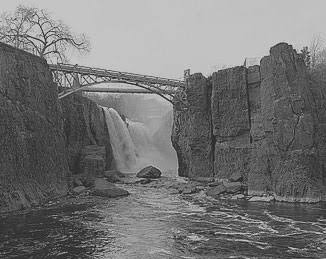
We owe our beginning for Paterson, New Jersey to Alexander Hamilton. To Hamilton’s pursuit of American manufacturing independence. To Hamilton’s interest in battling prohibitions placed upon free trade.
Paterson was established in 1791. And it was in 1791 that Alexander Hamilton – then, Secretary of the Treasury – set up the Society for Establishing Useful Manufactures (SUM). Proceeding to acquire 700 acres which would be developed as a catalyst for the growth of American manufacturing.
Those 700 Paterson acres are located close to a power source which is native to Paterson – the Great Falls.
Here we have our catalyst – the Society for Establishing Useful Manufactures – and our footprint – those 700 acres – for the 18th Century emergence of an American industrial center.
Hamilton’s vision for the Society for Establishing Useful Manufactures was anchored in his goal to transform Paterson into a major industrial hub.
Cotton emerged as an early product manufactured in Paterson. Soon giving way to textiles.
In time, silk would become the preeminent manufacture of Paterson. Paterson would go on to become “Silk City.”
The Great Falls of Paterson provided the power needed in “Silk City” to operate industrial sites. Industrial sites built around benefits flowing from the Falls.
Recognizing the potential in the Great Falls, Alexander Hamilton’s idea for an industrial site – and for an industrial city – could be realized through the construction of canals. Hamilton knew that canals would be able to deliver water power to industrial sites. Providing the power source – water – Paterson manufacturers could come to rely on.
A private-public corporation, the initial plan for the Society for Establishing Useful Manufactures was for the corporation to build, own and operate Paterson’s industrial sites – owner-operators.
That first strategy thought up for the Society for Establishing Useful Manufactures as an owner-operator changed. This early-day premise for the Society for Establishing Manufactures as owner-operator of industrial sites gave way to an amended blueprint. This amended blueprint being, for the Society for Establishing Useful Manufactures to become freeholder to Paterson industrial sites.
The Society for Establishing Useful Manufactures leased industrial sites around the Falls to private manufacturers. While retaining control over the power source manufacturers relied upon – the Great Falls.
The Society for Establishing Useful Manufactures transitioned from manufacturing into real estate development. Becoming a prominent real estate developer in Paterson through the early part of the 20th Century.
Paterson becoming an industrial hub was a late-18th Century goal arising from the importance Alexander Hamilton placed on manufacturing independence.
Manufacturing independence. Economic independence. Industrial independence.
The 700-acre site acquired by the Society for Establishing Useful Manufactures around the Great Falls was a foundation upon which the emergence of an American manufacturing empire could be begin. The birth of Paterson.
The American Colonies gained their independence from Great Britain in 1783. With the signing of the Treaty of Paris. Two years after General Cornwallis surrendered at Yorktown.
The Treaty of Paris was signed. The Colonies were no longer subjects of the King. Yet these new Colonies were still reliant upon Great Britain. Hence, Hamilton’s idea for the Society for Establishing Useful Manufactures. Hence, our backdrop for the emergence of Paterson.
The year of the Treaty of Paris – 1783 – Colonial imports from Great Britain totaled just about $300,000, in 18th Century dollars.
The year after the Treaty of Paris – 1784 – Colonial imports from Great Britain totaled just about $600,000, in 18th Century dollars.
Imports from Great Britain doubled the first year of America’s independence. America did gain its independence from Great Britain. While at the same time, increasing their dependence on Great Britain. For imports.
Exports from Great Britain to the Colonies increased substantially after the Colonies’ independence. While Parliament was placing “tariffs” on manufactured goods the Colonies intended to export to Great Britain.
These British “tariffs” were called Duties. Duties represented constraints pushed onto Colonists, serving as barriers to Colonial exports to Great Britain. And this problem of duties was compounded by a stranglehold-of-a-requirement imposed on the Colonies through Parliament.
Great Britain commingled their imposition of Duties on American exports with an additional constraint. An additional constraint meant to further restrict American exports to Great Britain. This additional restriction being, American exports to Great Britain were required to be transported by British vessels only. Confiscatory trade policy enacted through Parliament which dampened manufacturing in the Colonies.
Trade restrictions placed upon Great Britain’s newly-independent “trade partner” did not stop at duties and a ship-British mandate.
Parliament permitted only the importation of non-manufactured American goods. It was non-manufactured goods only. Great Britain, as the world’s largest economy, placed restrictions on imported American manufactured products to protect manufactures at home.
In 1783, as a newly-independent country, the Colonies were “free” to export to Great Britain. So long as the Colonies did not export manufactures.
This protected British manufacturers from newfound Colonial competition. While at the same time, preventing the emergence of well-trained, English-speaking competitors to British manufacturers – American manufacturers.
Furthermore, Great Britain – through their Colonies, when they were Colonies of Great Britain – enjoyed prosperous trade with the British West Indies. A different outpost within the same British Empire.
Yes, the Colonies gained their independence from Great Britain. In 1783. The Colonies gained their independence while at the same time increasing their dependence upon Great Britain in different sort of way. This, a dependence found in reliance upon British manufactures. Manufacturers in Great Britain who exported their finished products to the Colonies. The inverse for which was highly restricted. Through Parliament.
The British West Indies remained, the British West Indies.
Britain enacted protectionist policies when dealing with the Colonies. Prohibiting free trade for the Colonies within the Empire. Which included the British West Indies.
The Colonies were “free” to trade with the British West Indies. So long as that trade was in non-manufactured goods. And so long as trade with the British West Indies involved the transportation of non-manufactured goods to the British West Indies (and to Great Britain, for that matter) on British vessels.
American livestock? The trade of American livestock was fine…trade away. So long as American livestock was shipped within the British Empire on British vessels.
American lumber? The trade of American lumber was fine…trade away. So long as American lumber was shipped within the British Empire on British vessels.
American flour? The trade of American flour was fine…trade away. So long as American flour was shipped within the British Empire on British vessels.
The trade of American manufactures? Of American finished goods? No deal. No trade. There was to be no shipment of American manufactures to Great Britain, nor to the British West Indies. Not on British vessels. Not on American vessels.
Great Britain was protecting their global manufacturing dominance. While in the Colonies, the Secretary of the Treasury recognized challenges arising from the unfair British trade restrictions. The Secretary of the Treasury in the Colonies intended to alter an unfavorable outcome. Alexander Hamilton was the Secretary of the Treasury.
Hence, our catalyst for Alexander Hamilton’s focus on developing the American Colonies into a manufacturing power that could one day compete with Great Britain.
Hence, our catalyst for the emergence of American industrial cities.
Hence, our emergence of Paterson as an industrial hub.
It had been those trade restrictions – enacted by Great Britain through Parliament after the Colonies gained their independence – which led Alexander Hamilton, as Secretary of the Treasury, to create a framework necessary for the growth of American manufacturing. Then, so too, for the growth of American industrial cities. Cities such as Paterson.

