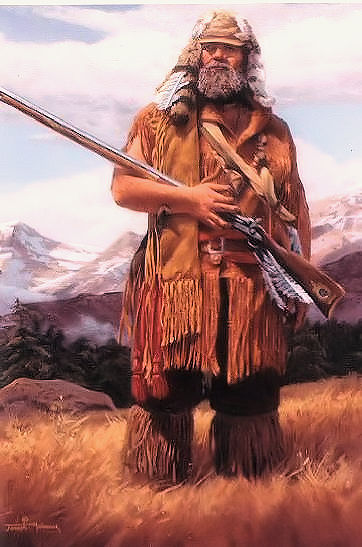
Ottawa, Kansas was founded on September 6, 1864 along the Marais des Cygnes River as a reservation for the Ottawa, Kansas tribe. The Marais des Cygnes River runs right through the center of town. The Marais de Cygnes was named by 17th Century visitors to Ottawa – explorers and trappers from France.
Explorers and trappers from France were drawn to Ottawa by prospects arising through the lucrative local fur trade with Native American tribes. By the late 1600s, French explorers known as coureurs des bois – the translation for coureurs des bois is, woodsmen – journeyed throughout eastern Kansas, pursuing beaver and otter pelts. Beavers and otters are native to eastern Kansas. Translated from French to English, Marais des Cygnes River is “Marsh of the Swans.”
The source of the Marais des Cygnes River is found in east-central Kansas in Wabaunsee County, near Eskridge.
The mouth of the 217-mile long Marais des Cygnes touches Little Osage River in western Missouri.
At the point where the Marais des Cygnes River empties into the Little Osage River, the two rivers join to become the Osage River. The reach of Marais des Cygnes River in Ottawa encompasses 9 miles of Midwest riverbanks.
Ottawa’s early settlers envisioned the Marais des Cygnes River as navigable maritime asset which would prove to be useful in transporting agricultural products – such as grain – to outside markets. However, what Ottawa’s first residents soon discovered was that their stream was shallow. At its deepest point in Ottawa, the Marais des Cygnes River measures only four feet deep. And…the steam meanders.
During dry seasons, the water depth of Marais des Cygnes drops significantly. Furthermore, its riverbed consists of a solid rock bottom…exposed during the dry season. In relation to Ottawa’s economy, the river’s purpose went from navigation to powering of mills.
Ottawa’s early mills were built in the latter part of the 20th Century, mostly along Walnut Street, close by North Main Street. Just a stone’s throw from the Marais des Cygnes.
The Ottawa Mill was built in 1867 at the intersection of Main Street and First Street. Forest Mills was constructed in 1872 at the corner of 1st Street and Walnut. Ottawa Oil Mill went up in 1873 on Walnut Street, just north of the Marais des Cygnes. The Excelsior Mill – built in 1881 – was found at the corner of Main and Tecumseh Street.
The Marais des Cygnes River functioned as a reliable energy source for Ottawa’s mills. The mills used water power to turn their heavy mill wheels. Through the utilization of buhrs made of stone, Ottawa mills produced 20,000 pounds of processed grain products, daily.
While the Marais des Cygnes River provided the initial idea upon which Ottawa commerce could be built upon, and while Ottawa was not set up as a railroad town, it ended up being the advent of the railroad which contributed to the town’s growth.
Constructed using limestone extracted from nearby hills, Ottawa’s original depot was built in 1888. The town’s depot was designed by one of Ottawa’s most prominent citizens, George Washburn.
George Washburn was the local architect. And a prominent architect, at that.
After working as a carpenter In Kansas City, George Washburn set foot in Ottawa in 1882, establishing himself as skilled tradesman.
George Washburn was an architect. An architect from Ottawa who would go on to make several noteworthy architectural contributions to Ottawa, and to Kansas, beyond Ottawa.
George Washburn designed nine Carnegie library buildings, as well as 13 county courthouses. Among the Kansas courthouses Washburn designed was the courthouse found in his hometown of Ottawa – Franklin County Courthouse. Washburn’s design for the Franklin County Courthouse integrated a tasteful blending of two styles: 1) Romanesque Revival, and 2) Colonial.
The Ottawa depot design Washburn came up with was part of a larger rail yard, a rail yard which consisted of a 13-stall roundhouse for engine repairs, as well as a freight depot.
You can visit Ottawa’s original depot today – it’s now a museum.
Ottawa’s Old Depot Museum is located at 135 W Tecumseh Street. Old Depot Museum sits at the northernmost trailhead of the Prairie Spirit Trail – a bike and walking trail. The Depot is not far from Forest Park and Haley Park.
You can’t buy Amtrak tickets at the Old Depot Museum. No trains arrive at Old Depot Museum. What you will find at Old Depot Museum is the Model Railroad Room, complete with HO-scale model train layout depicting 1950s rail lines. You will also find a recreation of a 19th Century schoolhouse, a Victorian parlor, a Soda Fountain Room and the General Store.
Using Washburn’s plans, Kansas City, Lawrence, and Southern Kansas Railway – now part of Santa Fe Railroad – built Ottawa’s depot. By the time two additional railroads – Leavenworth, Lawrence & Galveston Railroad and Missouri Pacific Railroad – arrived in Ottawa, the town became a busy transport. Ottawa’s depot was primarily a passenger depot, although adjacent freight-handling structures were soon built next to the depot.
The first train pulled into Ottawa’s depot in 1888. The last train left Ottawa’s depot in 1962. At which time the Sata Fe Railroad donated the Ottawa’s depot to the Franklin County Historical Society.
 Thinking About Becoming a Real Estate Developer?