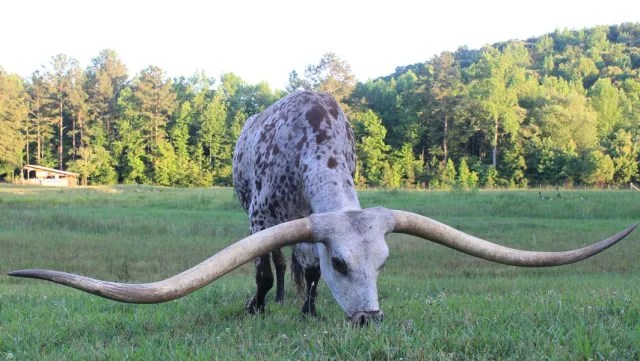
The origin of the name? Their distinct, pronounced long horns. Long horns which can exceed 8 feet in width. From tip to tip.
Bulls weigh between 1,500 to 2,000 pounds. Cows weigh less. On average, 1,000 pounds.
The Texas longhorn.
Texas longhorn color is unique to the breed. Texas longhorn colors vary. And vary they do. Quite a bit.
Just about four-out-of-ten Texas longhorns proudly wear their light red coat. The Texas longhorn coat might also be black. Or yellow. Or brown. Or white. Or brindle. The Texas longhorn coat could also be blue. Blue, that is, with a gray-ish tint.
At auction, the color category of the Texas longhorn have bestows a distinct identity.With rarity in color for the Texas longhorn correlating to a higher price fetched at auction.
Facing near-extinction one hundred years ago, thinning during the 1960’s to a dangerously-low head count, while today the Texas longhorn is primarily found in Texas, the breed confidently grazes – no longer facing extinction – on ranches throughout the United States. A “trophy” on any ranch.
Long, long ago, the Texas longhorn was known as “Texas cattle.” Ancestors of “Texas cattle?” “Mexican cattle.”
Descendants of the Texas longhorn were first introduced to North America during the 1400’s. Finding their way here, thanks to Spanish explorers. The introduction of the Texas longhorn to our prairies dates back to the days of Christopher Columbus. To the days when Columbus led his expedition to the Americas.
With regard to the introduction of the Texas longhorn to North America, the Texas longhorn came ashore in Mexico. From Mexico, as Spanish explorers ventured north into what would go on to become Texas, the Texas longhorn accompanied Spaniards on their northern ventures. Hence, the introduction of “Mexican cattle” to a territory which would one day go on to become Texas.
Cattle brought to North America by Spaniards. “Mexican cattle” led north to Texas. “Mexican cattle” renamed “Texas cattle.” “Texas cattle” renamed “Texas longhorns.”
As more Spanish settlements in the Americas took hold, as the number of settlements established in the Americas by additional European countries grew, so too did grow cattle head count on the continent. Head count for the Texas longhorn increased.
Spaniards reached today’s Texas by the end of the 17th Century. With Spaniards arriving in Texas, along too, came their longhorns.
The Texas longhorn footprint expanded. North into Texas. To the east, into Louisiana.
As cattle head increased, inevitably, some head were bound to escape from captivity. And escape, some did.
Found among escaping Spanish cattle in Texas, our foundation for the history of the Texas longhorn in the United States begins.
Escaping longhorns…
The Texas Longhorn roamed Texas – roaming freely, upon their escape from captivity – through the final days of the 19th Century. At which time, the cattle industry changed Texas longhorn fate.
Late in the 19th Century, the Texas longhorn began to be rounded up en masse. Rounded up and loaded onto rail cars. To be shipped off. Shipped north, that is. To Kansas City slaughterhouses.
Ten-year totals for head of cattle shipped north to slaughterhouses during the last decades of the 1800’s exceeded 5,000,000 head. Over 5,000,000 head of cattle shipped north, per decade.
Those prairies the Texas longhorn escaped to were perfect for grazing. Upon the escape of the Texas longhorn from captivity, the Texas longhorn was not alone on the prairie. The longhorn had company.
The Texas longhorn escaped to what had been “bison country.” In “bison country” the Texas longhorn lived free as, as the bison’s neighbor. Bison and the Texas longhorn, alongside one another for centuries.
That neighborly existence of bison and longhorn began in the 15th Century. When the longhorn was first brought to the western hemisphere. Brought from Europe. Aboard Spanish ships.
In the 15th Century, longhorn count in North America had been low. North American settlement by Europeans – as well as the introduction of cattle to North America – was in its infancy.
Fast forward a few hundred years to the Texas longhorn’s prime. The last days of the 19th Century.
As the 19th Century drew to a close, that “bison country” the Texas longhorn escaped to was subjected to an extermination. This was an extermination at the hands of the United States government.
In the late 1800’s, “bison country” was in the process of being cleared. Cleared of bison. Cleared by the government of the United States.
United States prairies cleared of bison. This, a concerted effort undertaken by the United States to rid the western corridor of the country of the primary food source of Native Americans. Native Americans, whom the United States government was intent on removing from their land, hunted bison. Eliminating the bison. Eliminating Native Americans. Opening up the west for United States expansion.
The Texas longhorn thrived in “bison country” when they arrived. The Texas longhorn thrived in “bison country” for hundreds of years. Thriving alongside bison.
The removal of the Texas longhorn’s competition for rich prairie grasses – this removal being the extermination of bison by the United States government – as the Civil War was coming to a close led to what would turn into the United States’ southwest becoming blanketed by cattle.
Head count of cattle increased. Head count of the Texas longhorn increased.
Prime years which encompassed the run for the Texas longhorn as a major contributor to the economy of Texas – and to bottom lines for Kansas City slaughterhouses – would be late in the 18th Century through the first two decades of the 20th Century.
By the 1920’s, the United States southwest was undertaking a notable increase in private property ownership. Private property, that is, which would now be fenced off.
The increase in private land ownership by individuals in Texas – as well as in the United States’ southwest – by the 1920’s substantially curtailed the Texas longhorn’s once unimpeded access to thousands of acres of rich grassland. The Texas longhorn’s food source – that open grassland – was significantly altered.
Between 500,000 to 1,000,000 head of cattle were shipped by train from Texas to Kansas City annually during the latter days of the 19th Century.
By the mid-1960’s there were fewer than 2,000 Texas longhorns in the United States. Total.
Once nearly wiped from existence entirely, today, Texas longhorn head count exceeds 300,000.
The reemergence of the Texas longhorn in Texas, as well as on privately-owned ranches throughout the United States, firmly re-established.
Today, if you are looking to purchase one Texas longhorn, you can expect to write a check for between $2,000 to $5,000. At a minimum.
For breeds of the Texas longhorn, breeds with a horn width considered to be wide, tip-to-tip (T2T), the price paid for one head will increase. The wider the T2T, the higher the price for one Texas longhorn.
The color of a Texas longhorn also affects its price.
The coat of the Texas longhorn sports an interesting array of desirable color coordinations.
Three Texas longhorn coat categories have traditionally been acknowledged to be the most highly-sought after: 1) White Roan, 2) Brindle, and 3) Grulla.
The Texas longhorn with the White Roan coat also possesses a red-ish pigment. Influenced by a roan gene. The result? The Texas longhorn whose coat is blue-ish in color.
The Texas longhorn with the Brindle coat? That Texas longhorn will own vertical black stripes.
The Texas longhorn with the Grulla coat? That Texas longhorn would be silver-ish in color.
Should you decide to purchase one Texas longhorn, one whose genetic history can be documented to be of “championship pedigree,” that $2,000 to $5,000 check you’d write to buy one head would increase. Increase substantially. To a few hundred thousand dollars. For one head.
The top price paid for one Texas longhorn? $700,000.






 Thinking About Becoming a Real Estate Developer?