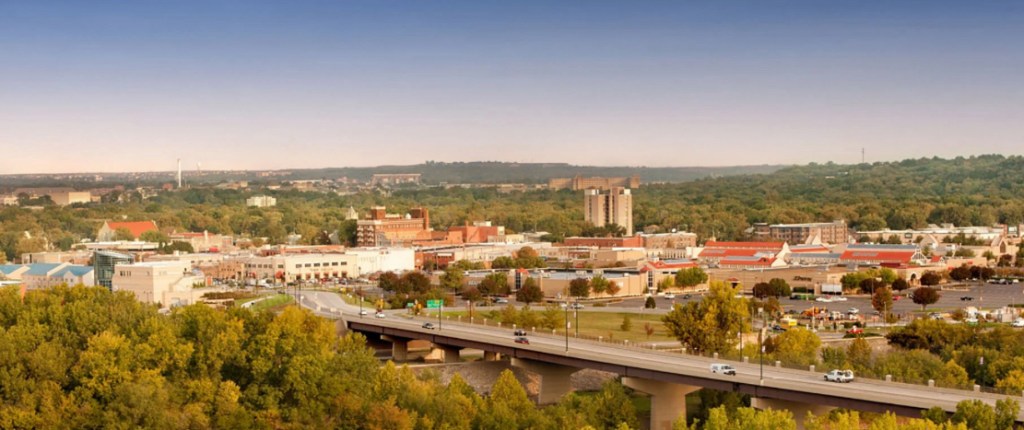
In 1854, when President Franklin Pierce signed the Kansas-Nebraska Act into law, a new Kansas Territory was opened for settlement. That same year, seeds were planted for one such riverside settlement within this new Kansas Territory. A settlement that would go on to become “The Little Apple.”
Steps taken by pioneers to establish what would go on to become “The Little Apple” -aka, Manhattan, Kansas – should be thought about with the Kansas-Nebraska Act also in mind. This is so due to the relationship the Kansas-Nebraska Act had to the institution of slavery. To how the Act served as a catalyst for Kansas’ formation. To how the Act fueled the antislavery movement in Kansas. Then too, to how the Act served as the precipice for the early organizers of a townsite which would evolve into “The Little Apple.”
So how do we connect Manhattan’s formation to the Kansas-Nebraska Act? Then too, to the antislavery movement? This connection really begins, with a Senator from Illinois…
In 1854, Illinois Senator Stephen Douglas introduced a bill to Congress. This bill that Senator Douglas introduced to Congress was the Kansas-Nebraska Act.
Senator Douglas’ bill – which President Pierce signed into law the same year the bill was introduced – ended the Missouri Compromise. The Missouri Compromise banned slavery in states north of an established latitudinal designation. Minus, one state, Missouri. Missouri’s exclusion from the ban of slavery, being, the “Compromise.”
While doing away with the Missouri Compromise, the Kansas-Nebraska Act also organized two new territories for the United States. These two new U.S. territories being, one, the Kansas Territory, and, two, the Nebraska Territory.
Two new U.S. territories were organized. The Missouri Compromise was ended. Without the Missouri Compromise, the two new U.S.territories would be free to enact “popular sovereignty.” And this popular sovereignty, within Douglas’ Kansas-Nebraska Act, related to whether slavery would become an institutional pillar within each of the two new U.S. territories.
So, with President Pierce’s signing of the Kansas-Nebraska Act, the race was then on to settle these two new territories. And, to settle the territories with positions on slavery which would thus, in turn, be representative of the viewpoints pertaining to the institution of slavery espoused by the early framers of the territories.
Popular sovereignty was in. The Missouri Compromise was out. The Kansas-Nebraska Act was in. What remained to be either in or out, was, the institution of slavery.
The same year the Kansas-Nebraska Act was signed into law by President Pierce, a settlement took hold in the Kansas Territory at the junction of the Kansas River and the Big Blue River. This, a riverside settlement founded by Colonel George Park. Colonel Park named his settlement, Poleska.
As Colonel Park founded Poleska, another group of pioneers heading into the new Kansas Territory – this group, cattlemen from Illinois, led by Samuel Houston – founded a neighboring settlement. Their neighboring settlement, Canton.
Popular sovereignty. No Missouri Compromise. And two new settlements in the Kansas Territory.
One year after Colonel Park founded Poleska, one year after Samuel Houston founded Canton, we find the structural framework for what would go on to become, “The Little Apple.” Manhattan.
Our framework for Manhattan, inspired by the popular sovereignty which came to be in the Kansas Territory. As the Missouri Compromise, was no more.
One year after the settlements of Poleska and Canton were founded, in 1855, a group of New England abolitionists traveled to this new Kansas Territory. From Boston. With popular sovereignty in mind, these New Englanders wanted to establish a Free State for this new Kansas Territory. They realized that they could do so. By increasing the number of antislavery voters in the Kansas Territory. Thus, with a majority of antislavery voters, ensuring that when Kansas did become a United States state, Kansas would enter the Union, as a free state.
These abolitionists from Boston – the New England Emigrant Aid Company – selected the contiguous Poleska-Canton settlements as their new Free-State home. Their new Kansas Territory home, located alongside those two Kansas rivers. The Big Blue River. And the Kansas River.
Recognizing how their settlement could develop reliable channels for commerce as a result of the settlement’s strategic position alongside two rivers, a river landing was built. With a river landing, then, ferries were built. Means of waterway commerce was established. A town constitution was adopted. The pioneers from Boston proceeded to acquire acreage. With their land acquisitions, the footprint of this new antislavery settlement, had been enhanced.
Yet, this antislavery settlement, was not yet a town. This settlement was not yet, Manhattan.
Manhattan was once, Boston…
This townsite, nestled alongside the Kansas River and the Big Blue River was still known as – just as this townsite had been known to be, since its founding by Boston settlers – Boston.
The name Manhattan would indeed come…not long after.
The same year the New England Emigrant Aid Company arrived at the Poleska-Canton settlements, another group – this group, with their origin being, Cincinnati, Ohio – also arrived. And it was this second group, from which, our Manhattan name, came to be.
This second group was the Cincinnati and Kansas Land Company. The Cincinnati and Kansas Land Company arrived at the Poleska-Canton settlements, also in 1855. Making their journey to the new Kansas Territory, on a steamship.
Upon arrival, ready to put up buildings. And houses. To further develop the commerce which was still in its infancy – in year one – within the Poleska-Canton settlements.
As an inducement to advance commerce, the New Englanders offered the Cincinnati and Kansas Land Company half of their Kansas Territory townsite of Boston.
Our new Kansas Territory group from Cincinnati accepted the stake holding offer. With one condition. This condition being, the townsite name would need to be changed. From Boston. To Manhattan.
A deal was struck.
Manhattan, Kansas was founded in 1855. Two years later, Manhattan, Kansas was incorporated.
The Little Apple.

 Thinking About Becoming a Real Estate Developer?