Kansas City, Kansas’s beginning came to be by way of a merger of towns. A merger of towns which then became KCK neighborhoods.
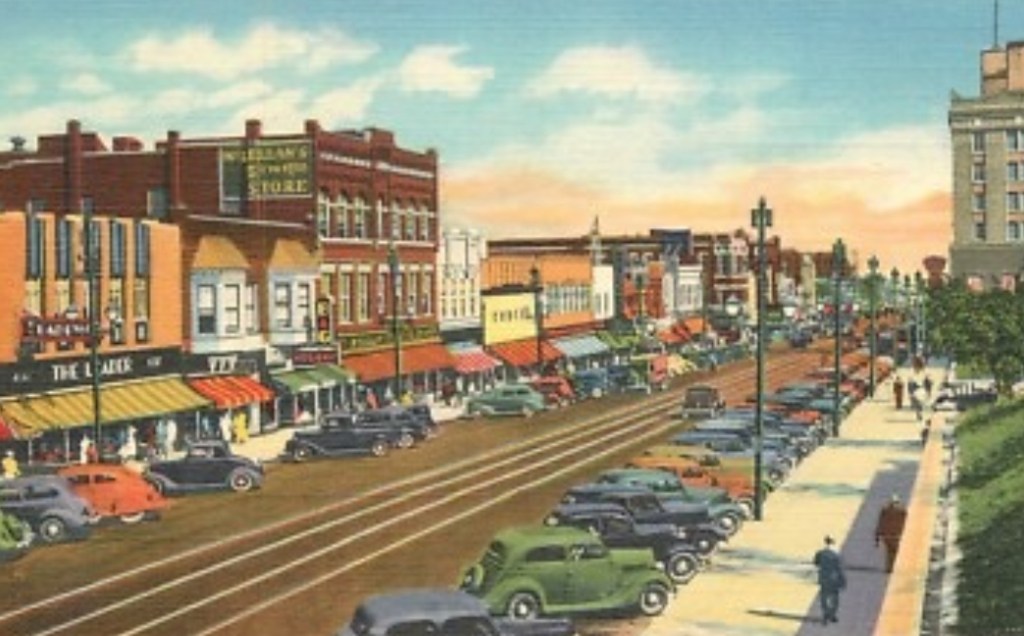
In 1886 Kansas City, Kansas was formed when the independent settlements of Kansas City, Wyandotte City, Armstrong, Riverview and Armordale combined.
Twenty-four years later, Kansas City annexed Argentine. Argentine was built around smelting and mining plants. Argentine’s plants, benefitting from Argentine’s location alongside the Santa Fe Railroad.
Today’s KCK neighborhood of Argentine borders Rosedale.
Prior to its annexation by Kansas City in 1922, Rosedale had been The Town of Rosedale. Settled in 1872.
Annexed by Kansas City in 1923, Quindaro was originally a free state port alongside the Missouri River. Within the abolitionist movement, Quindaro was once an Underground Railroad station.
During the latter part of the 19th Century, goods making their way to the Western-most points of an ever-expanding United States would have likely ended up trekking through Paris of the Plains. Through Kansas City. Through Crossroads.
Kansas City was (and is) truly an American Crossroads.
In a fast-industrializing early-20th Century United States, Kansas City – I.e.: Crossroads – connected an industrial Northeast to agricultural centers in the American west. And in the American southwest.
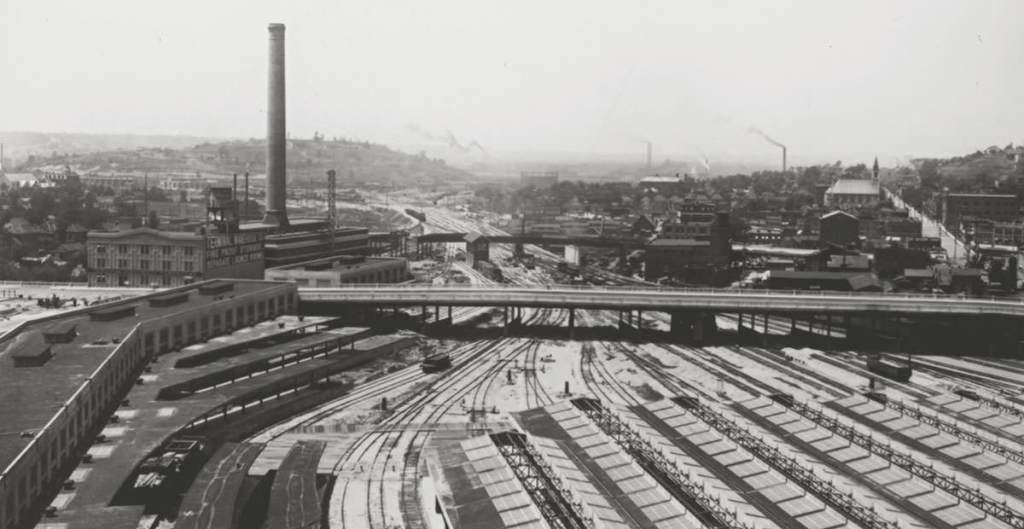
The Santa Fe Trail. Kansas City’s unique location at the confluence of two major rivers – the Kansas River and the Missouri River. And later, as a major railroad hub. A railroad hub which, during its heyday, was second only to Chicago’s railyards in terms of rail traffic, and rail capacity. Each converged in Kansas City. Kansas City became a Crossroads. Due to its geographical location. Due to America’s expansion west. Due to rail. Due to trade patterns. Crossroads…
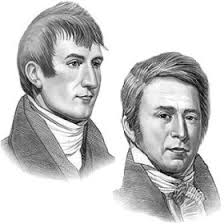
Lewis and Clark arrived in Crossroads at the onset of the 19th Century. Lewis and Clark arrived in Crossroads at a time when the United States government was keen on opening up the west to American interests. The most effective pathway west at that time? That would have been the Missouri River. Kansas City was built alongside “Big Muddy.” Built alongside the Missouri River.
Switching eras. Fast forwarding in time. Switching methods of transportation. Yet staying on the subject of Crossroads..
In order to facilitate Kansas City’s unique position as an American Crossroads, nearly 100 years after Lewis and Clark arrived with their team of 50 – and 3 boats – by the late-19th Century, the first train depot opened in Kansas City. The year was 1878. And that Crossroads train depot would have been Kansas City’s Union Depot.
Kansas City’s Union Depot became the second union depot which opened in the United States. Indianapolis’s union depot was the first.
By 1945, nearly 700,000 rail passengers stepped foot in Kansas City’s train station. At its height, close to 200 trains pulled into Kansas City every single day. Crossroads.
A Crossroads. A gateway. To an exciting new 19th Century American frontier. A Crossroads for 20th Century American train travelers. A Crossroads for American soldiers during wartime. A Crossroads for American industry. A Crossroads for freight trains. Crossroads.
In the mid-20th Century, rail was the preeminent method of transportation for freight. In the mid-20th Century, rail was the preferred method of transportation for civilian passengers. As an American Crossroads, Kansas City quickly outgrew its original Union Depot.
Desiring – and requiring – additional capacity for their freight trains, the railroads which were collectively utilizing Kansas City’s Union Depot in KC’s industrial West Bottoms made a decision. Their decision? They were going to replace the outdated, ill-sized Union Depot with a new, larger more accommodative train station. Built in a new location. Union Depot was out. A depot in the West Bottoms – as the West Bottoms was prone to floods – was out. The new Kansas City train station would be near Kansas City’s central business district. Not in a floodplain. Built up on the hill.
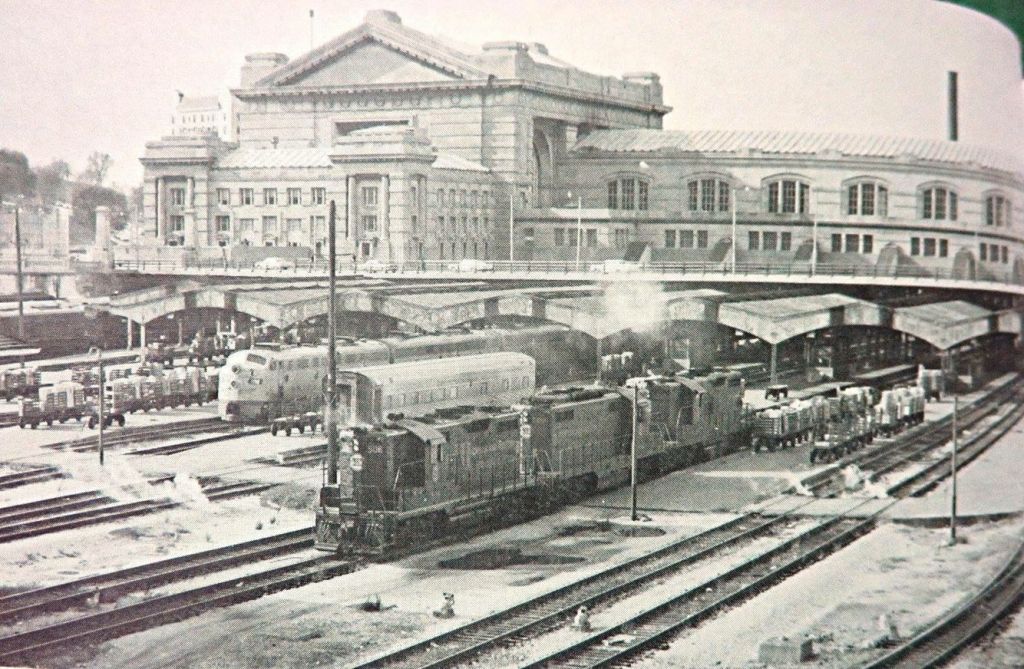
Kansas City’s Union Station opened to the public in 1914 – a 850,000 square feet major railway hub. Union Station prospered. Rail, at that time, was an integral part of Kansas City’s position as an American Crossroads. Yet, as Union Station – and as rail – cemented Kansas City’s Crossroads status, macro circumstances in the United States changed. Macro circumstances changed the future of Kansas City’s Union Station. Macro circumstances changed the utilization of Kansas City’s Union Station. Macro circumstances changed the fate of Kansas City’s Union Station.
As the 20th Century progressed, the preferred method of transportation in the United States changed. For civilian passengers. For industry.
An emerging airline industry – coupled to travelers’ newfound preference for convenient flights, rather than long train rides – changed how Kansas City functioned as a rail-centric Crossroads. And trucks. Highways.
As flights replaced rail for passengers, trucks and highways replaced rail as the preferred method of transportation for freight. As such, the “DNA” for Crossroads changed.
By the 1970’s, rail traffic through Kansas City’s Union Station dropped. Significantly. From what had been a near-700,000 train passengers walking through Kansas City’s Union Station each year…that number precipitously dropped. Year by year. To, in the early part of the 1970’s, just about 30,000 yearly passengers.
At one time, close to 200 trains pulled into Kansas City’s Union Station everyday. Today? A total of 4 Amtrak trains pull into Union Station, daily.
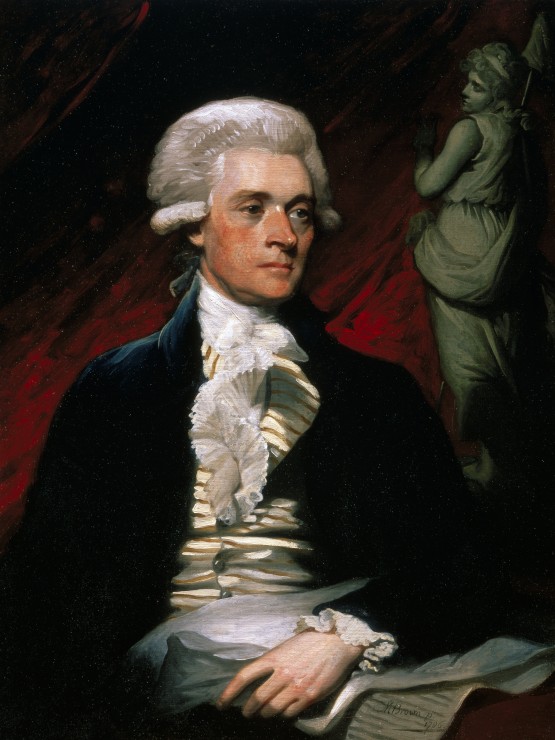
Through it all, the origin for Kansas City’s status as a Crossroads? I would say, that was never Union Station. It was not the nearly-200 trains which pulled into Kansas City each day. It was not the American GI’s who arrived in Kansas City during the War. The origin for Kansas City’s status as Crossroads? That would be one United States President. The origin for Kansas City’s status as Crossroads would be, in my humble opinion, Thomas Jefferson.
In 1803, the size of the United States doubled. The doubling in size of the United States in 1803 was the result of one $15,000,000 real estate deal. That real estate deal being the Louisiana Purchase.
The Louisiana Purchase added 828,000 square miles to the footprint of the United States. And, once the Louisiana Purchase was enacted, Kansas City’s location went from perfect, to PERFECT.
One year after the Louisiana Purchase, President Thomas Jefferson tapped an old wartime buddy of his. That buddy? Meriweather Lewis. Jefferson’s idea? For Meriweather Lewis to lead an expedition west. For Lewis to explore this vast new territory acquired by the United States through the Louisiana Purchase.
Meriweather Lewis added William Clark to this planned expedition. Six weeks after the Jefferson-directed expedition began, Lewis and Clark arrived at a confluence of two important rivers. The Missouri River. The Kansas River.
Or, as we now know this area to be, six weeks after Lewis and Clark ventured out with 3 boats – and a team of 50 – Lewis and Clark arrived at Crossroads. Lewis and Clark arrived in, what would go on to become…Kansas City.
Kansas City… Kansas City, Missouri. Kansas City, Kansas.
There had been a few different beginnings for what we now know to be Kansas City. The very first one?
In the 1830s, we had the first one – Westport Landing.
Westport Landing was established on a section of 257 acres which would evolve into what would become Kansas City, Missouri.
The 257 acres had been sold by the federal government to a man of French ancestry…Gabriel Prudhomme. This land sale took place in 1831.
Whereas the land Gabriel Prudhomme purchased from the federal government would go on to become Kansas City, Missouri, Westport Landing was the early, pre-Kansas City, Kansas City development.
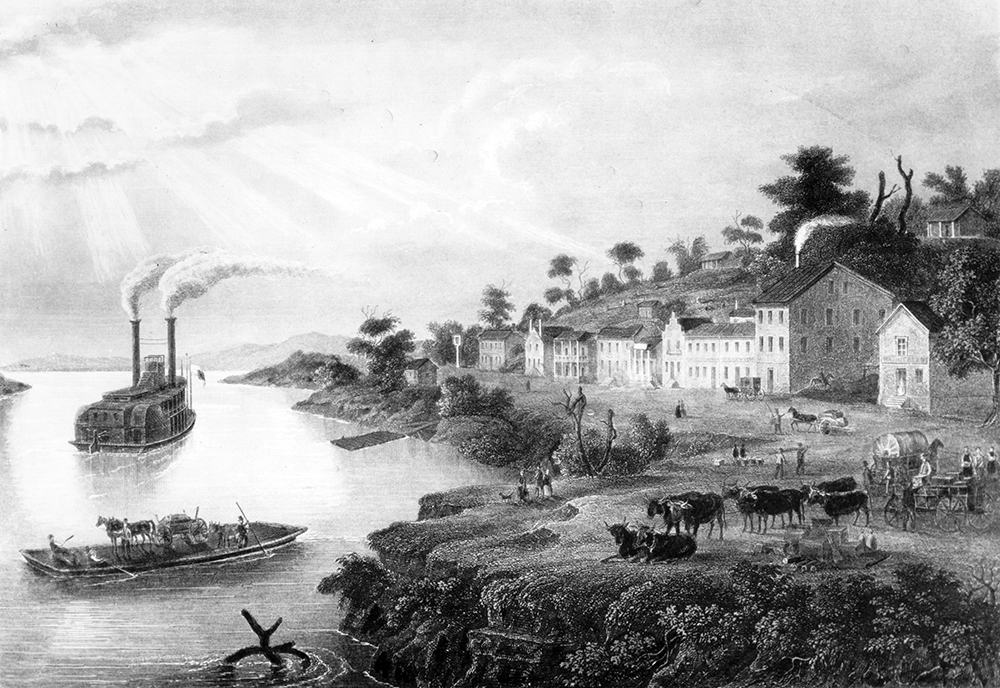
Westport Landing – strategically set up alongside the heavily-trafficked Santa Fe Trail – was an unincorporated collection of merchants. These were merchants who established their businesses in Westport Landing to provide Santa Fe Trail travelers with supplies.
The merchants were inland. And the Westport Landing merchants figured out they could reduce their costs by receiving supplies by way of the Missouri River. Rather than by land. And they did.
The waterway entry point at which Westport Landing merchants were able to receive supplies shipped to them on the Missouri River was located where what is now Grand Boulevard in Kansas City, Missouri intersects with the Missouri River. And it is at this intersection – where Grand Boulevard meets the “Big Muddy” – where we found Westport Landing.
Twenty years later – in 1850 – Westport Landing was incorporated as the Town of Kansas.
Three years after that – in 1853 – the Town of Kansas was reincorporated and renamed. The new name for the Town of Kansas? The City of Kansas. And this renaming – as the City of Kansas – took place eight years before the State of Kansas became the 34th state of the United States. In 1861.
In 1889, the name for the city – the City of Kansas – was changed. Changed to Kansas City. The very, very first Kansas City – that first Kansas City being, Westport – was annexed by Kansas City, Missouri eight years later. In 1897.
All the while, on the other side of the Missouri River – in the new Kansas Territory – small Kansas settlements were forming. And growing. Growing into small Kansas towns.
In 1872, a consortium of small Kansas towns – on the other side of the river – merged. And incorporated. Therein – in 1872 – we have the origin for Kansas City, Kansas.
Wherein the larger Kansas City – and the older Kansas City, too – is the one which is located in Missouri, and not in Kansas, the “Kansas” in Kansas City is not derived from the State of Kansas.
The name of the city – Kansas City, Missouri – was named after a river. Not a state. Not Kansas. That river being…the Kanza River.
The Kanza River would go on to become the Kansas River. The Kansas River provided the name – “Kansas” – for the city – Kansas City, Missouri.
So the city – Kansas City – which originally formed as Westport Landing, which would later go on to become the Town of Kansas, which would later go on to become the City of Kansas, which would later go on to become Kansas City…does not derive its name from its neighbor to the west – the State of Kansas.
Kansas City… Kansas City, Missouri. Kansas City, Kansas.
There had been a few different beginnings for what we now know to be Kansas City. The very first one?
In the 1830s, we had the first one – Westport Landing.
Westport Landing was established on a section of 257 acres which would evolve into what would become Kansas City, Missouri.
The 257 acres had been sold by the federal government to a man of French ancestry…Gabriel Prudhomme. This land sale took place in 1831.
Whereas the land Gabriel Prudhomme purchased from the federal government would go on to become Kansas City, Missouri, Westport Landing was the early, pre-Kansas City, Kansas City development.
Westport Landing – strategically set up alongside the heavily-trafficked Santa Fe Trail – was an unincorporated collection of merchants. These were merchants who established their businesses in Westport Landing to provide Santa Fe Trail travelers with supplies.
The merchants were inland. And the Westport Landing merchants figured out they could reduce their costs by receiving supplies by way of the Missouri River. Rather than by land. And they did.
The waterway entry point at which Westport Landing merchants were able to receive supplies shipped to them on the Missouri River was located where what is now Grand Boulevard in Kansas City, Missouri intersects with the Missouri River. And it is at this intersection – where Grand Boulevard meets the “Big Muddy” – where we found Westport Landing.
Twenty years later – in 1850 – Westport Landing was incorporated as the Town of Kansas.
Three years after that – in 1853 – the Town of Kansas was reincorporated and renamed. The new name for the Town of Kansas? The City of Kansas. And this renaming – as the City of Kansas – took place eight years before the State of Kansas became the 34th state of the United States. In 1861.
In 1889, the name for the city – the City of Kansas – was changed. Changed to Kansas City. The very, very first Kansas City – that first Kansas City being, Westport – was annexed by Kansas City, Missouri eight years later. In 1897.
All the while, on the other side of the Missouri River – in the new Kansas Territory – small Kansas settlements were forming. And growing. Growing into small Kansas towns.
In 1872, a consortium of small Kansas towns – on the other side of the river – merged. And incorporated. Therein – in 1872 – we have the origin for Kansas City, Kansas.
Wherein the larger Kansas City – and the older Kansas City, too – is the one which is located in Missouri, and not in Kansas, the “Kansas” in Kansas City is not derived from the State of Kansas.
The name of the city – Kansas City, Missouri – was named after a river. Not a state. Not Kansas. That river being…the Kanza River.
The Kanza River would go on to become the Kansas River. The Kansas River provided the name – “Kansas” – for the city – Kansas City, Missouri.
And Kansas
So the city – Kansas City – which originally formed as Westport Landing, which would later go on to become the Town of Kansas, which would later go on to become the City of Kansas, which would later go on to become Kansas City…does not derive its name from its neighbor to the west – the State of Kansas.
 Thinking About Becoming a Real Estate Developer?