…how Rutgers University came to be.


Rutgers, The State University of New Jersey was founded – originally as a seminary – in 1766.

Founded by William Franklin. William Franklin, son of Benjamin Franklin.

Although, upon its founding, this college, located in New Brunswick along the Raritan River, was not known as Rutgers.

The name Rutgers was affixed to the New Brunswick college 59 years after its founding. In 1825. “Rutgers,” selected to honor Revolutionary War veteran Colonel Henry Rugers. Between the year of its founding – in 1766 – and the year Rutgers was selected as the college’s name, in the honor of Henry Rutgers – in 1825 – Rutgers had been Queens College. Then, for the next one hundred years, it was Rutgers College.
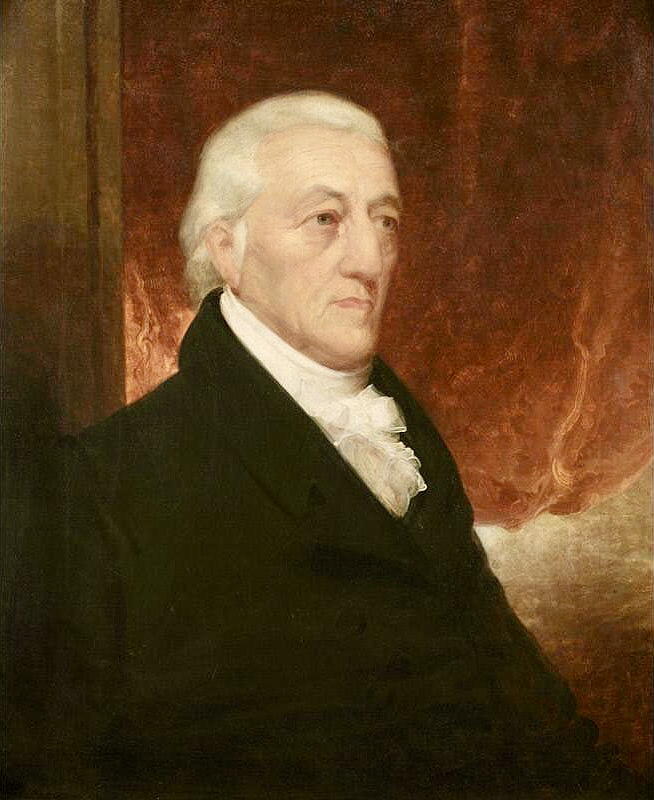

Henry Rutgers…

Born in New York City in 1745 – and in 1745, that would have been, the Province of New York, British America, as New York was still under British rule when Henry Rutgers was born – Henry Rutgers served as a New York state assemblyman. He was a graduate of Columbia University (then, King’s College),

A prominent New York landowner, Henry Rutgers donated much of his land to local New York City schools, charities, and churches. In Manhattan, if you have ever driven down Henry Street or Rutgers Street, those streets were named after Henry Rutgers.

Rutgers College – then Queens College – adopted Henry Rutgers’ name upon receiving a much needed financial infusion from Henry Rutgers.

Through Henry Rutgers’ generosity, prospects for the then-struggling Queens College to continue on as an institution of higher learning, brightened.

At the time of Henry Rutgers’ financial contribution, Queens College had incurred a multi-year shutdown. Its finances, and its future, cast astray as a byproduct of the challenging economic times the United States went through upon the conclusion of the War of 1812.

The University of Newark joined the Rutgers family in 1946. As Rutgers University-Newark.

The College of South Jersey joined the Rutgers family in 1950. As Rutgers University- Camden.

Rutgers is the second oldest university in New Jersey. Founded 20 years prior to Queens College’s founding, Princeton – which had been the College of New Jersey from 1746 until 1896 – is the oldest New Jersey university.

Rutgers’ Board of Trustees consists of 41 voting members. Rutgers’ Border of Trustees functions in an advisory capacity to Rutgers’ Board of Governors.

Rutgers’ Board of Governors consists of 15 voting members. Rutgers’ president is a non voting Board member.

Three of the 15 members of Rutgers’ Board of Governors are voting members, selected by the Rutgers University Senate. Three representatives – selected by the University Senate – are non voting representatives.

Eight members of Rutgers’ Board of Governors are appointed by the New Jersey governor. Seven members are selected by the Board of Trustees. For the 8 members appointed by the New Jersey Governor, confirmation for each member by the New Jersey Senate is required.

The president of Rutgers is a nonvoting Board of Trustees member. Rutgers’ University Senate selects two members of the faculty – as well as two students – as non voting representatives.

The selection of the 41 voting members of the Board of Trustees is done in accordance with State law.

There are 20 charter members. Three of the 20 charter members must be women.

Sixteen Trustees are Rutgers alumni, each of whom is nominated for Board membership by the Nominating Committee of the Board of Trustees.

Five Trustees are public members, appointed by the governor. The five public members who are appointed by the governor require confirmation by the New Jersey State Senate.

The president of Rutgers is selected by the university’s Board of Governors. The Board of Governors oversees the process of identifying the president, while overseeing the Presidential Search Committee.

Rutgers’ Presidential Search Committee develops a profile of prospective candidates…submitting recommendations of potential university presidents to Rutgers’ Board of Governors.

Rutgers’ Board of Governors, upon receiving recommendations and feedback from the Presidential Search Committee, ultimately selects the university president.

On two separate occasions – resulting from acts taken by the New Jersey Legislature – Rutgers was designated as the official state university of New Jersey. New Jersey’s legislature granted Rutgers this distinction in 1945. And once again, in 1956.
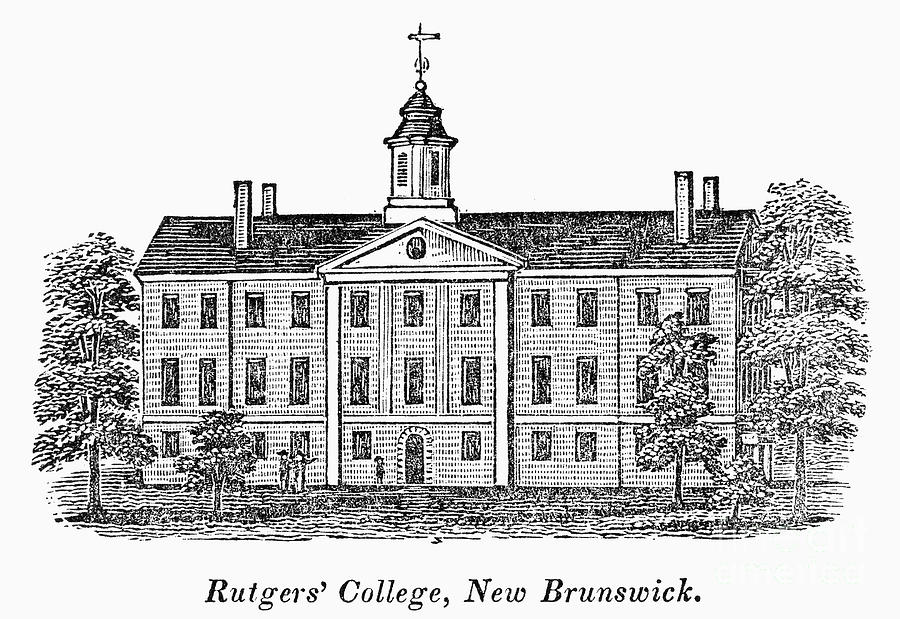
New Brunswick is a city in Middlesex County, New Jersey, United States

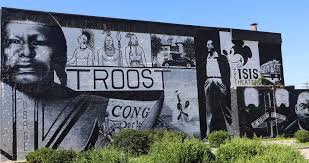
Kansas City’s Troost Avenue


There is an interesting, historically significant 10-mile street in Kansas City, Missouri which runs from 4th Street to Bannister. The Kansas City, Missouri street I am referring to here is Troost Avenue.

Among the Kansas City, Missouri neighborhoods which border Troost Avenue are…Beacon Hill, Longfellow, Squier Park, Rockhill and Hyde Park. All are fabulously sought-after KC neighborhoods.

Troost Avenue was named after a doctor – Benoist Troost. Dr. Troost, as well as being a prominent Kansas City physician, had been a civic leader in KC. Troost Avenue.

Troost Avenue was once home to “Millionaire’s Row.” Early in the 20th Century, “Millionaire’s Row” had been a strip of stunning mansions constructed all along Troost Avenue. Those mansions adorned Troost from 31st Street to 34th Street.


Today, Troost Avenue is experiencing keen interest. And a tasteful renaissance of redevelopment. In times past, Troost Avenue experienced a storied history of disinvestment. And decline. Prior to Troost’s renaissance. So what led to Troost’s decline?

Disinvestment. But real estate disinvestment was not the primary catalyst which led to Troost’s
mid-20th Century decline. Real estate disinvestment certainly was one catalyst which led to Troost’s decline. But
real estate disinvestment was not the primary catalyst which led to Troost’s decline.


Disinvestment in public schools east of Troost was the primary catalyst which led to Troost’s decline.

Starting off in the late ‘60’s, the School Board in Kansas City, Missouri consistently requested increases in education funding for Kansas City, Missouri schools located east of Troost Avenue. For this topic, there were in the range of twenty such education funding requests made by the Kansas City School Board during this time. These were funding requests made throughout 1960’s. Throughout the 1970’s. For twenty years.

The additional funds – if approved – would have gone to Kansas City, Missouri public schools east of Troost Avenue. Funding requests were voted down. The result? White flight.

Families – those having the means, that is…meaning, predominantly white families at that time – moved. Families moved outside of the underfunded Kansas City, Missouri School District. Schools east of Troost were underfunded.

White flight. Neighborhood home values decreased. One prominent Kansas City mayor once referred to Troost Avenue as, “…the demarcation line in a war zone.

The problem – east of Troost – wasn’t the legal segregation of schools. Nor was the problem – east of Troost – the illegal segregation of schools. The problem – east of Troost – was school funding. Or a lack thereof.


Long before round after round after round after round of failed requests were submitted to secure funding for Kansas City, Missouri public schools east of Troost, those same public schools were in fact desegregated. Yet school desegregation didn’t really solve this problem in Kansas City east of Troost. Because while school desegregation based upon race was the national mandate after Brown v. the Board of Education, decisions made which affected education funding were – and are – made at the local level. And therein was the problem for public schools east of Troost. At that time.


In 1954, the United States Supreme Court unanimously ruled in Brown v. the
Board of Education of Topeka, Kansas that state-sanctioned segregation of
public schools was unconstitutional. Prior to this 1954 Supreme Court ruling, in Kansas City, Missouri – east of Troost Avenue – Lincoln High School had once been the only high school providing post-elementary education to Black students.
One high school.


In 1955, one year after Brown v. the Board of Education, the Kansas City School Board kind of enacted a “segregation” of public schools, in a different way. This was like a “de-facto segregation.” Not based upon race. But rather, this was a different form of segregation which was based upon attendance zones. Not race.


Yet, do we recall the aforementioned white flight east of Troost? The white flight which took place as round after round of funding requests for schools was voted down? Which led to panic selling? Which led to block busting? As white families relocated out of the Kansas City, Missouri school district?

Kansas City, Missouri public schools east of Troost were not segregated based upon race after the 1954 Supreme Court decision. But yet, in a practical sense, they
kinda still were.


The city’s expansion…


Beginning in the 1950’s, and extending onwards through the 1960’s, Kansas City,
Missouri – as a city – grew. During this time, Kansas City, Missouri added over
200 square miles to the city’s footprint. Yet, during this same time, what about
Kansas City, Missouri public school sizes? What about Kansas City, Missouri public
school teacher count? What about Kansas City, Missouri public school classroom
sizes? What about Kansas City, Missouri public school classroom capacity?


None of those public school categories grew in a commensurate way – east of
Troost, that is – to Kansas City’s population growth. Nor to Kansas City’s
expanding public school education requirements. During the city’s expansion in the ‘50’s and ‘60’s – east of Troost – Kansas City, Missouri public schools remained overcrowded. And underfunded. The city’s expansion just made it worse.


In real estate, developers often utilize – and benefit from – tax abatements. On Troost Avenue – and east of Troost – there is a genuine renaissance which has taken hold. It’s long overdue. And it’s welcomed.


Let’s go back for a moment to the topic of Kansas City, Missouri public schools, east of Troost. To the underfunding of public schools, east of Troost. To classroom sizes…


The definition of a tax abatement is, the reduction of, or the exemption from, taxes granted by a government for a specific period, usually to encourage certain activities.


Over one six-year period – between 2017 and 2023 – Kansas City, Missouri public schools lost in excess of $200 million in potential education funding which could have gone (but didn’t go) to Kansas City, Missouri public schools. Funds redirected away from Kansas City, Missouri public schools due to development incentives given out. Development incentives coming from tax abatements.


Public schools in Kansas City, Missouri have accrued nearly $400 million in deferred maintenance. Underfunded.


Those of us who love Kansas City applaud the spectacular redevelopment which is taking place on Troost Avenue. Still, it’s not really a stretch for us to take a moment and think about what led to Troost’s decline. It was the schools.


If the #1 goal is redevelopment and private schools…all good.

While panic selling and block busting were two factors which contributed to neighborhood disruption east of Troost long, long ago, neighborhoods east of Troost will experience no such disruptions this time. As the “Troost pendulum”swings all the way…in the other direction.


What we’ll see is, not decreasing property values east of Troost. We’ll see increasing property values east of Troost.

We won’t see panic selling east of Troost. We’ll see home sellers fetching ever-increasing prices for their homes, east of Troost.

We won’t see blockbusting, east
of Troost. We’ll see continued investor interest in homes, east of Troost.

What we’ll also see – east of Troost – is community members being priced out of their neighborhoods. We’ll see gentrification. We’ll see investment. Not
disinvestment. We’ll see tax abatements.

We’ll also see hundreds of millions
of dollars in deferred maintenance which has already been incurred by Kansas City, Missouri public schools.


We’ll see challenges in education. Different education challenges. Not
segregation. Not the same challenges as before. But challenges in education
east of Troost, nonetheless.


If redevelopment on Troost Avenue is the goal, all good.

If there are other topics to consider, maybe we revisit Kansas City history? Focusing on this topic: public schools east of Troost.