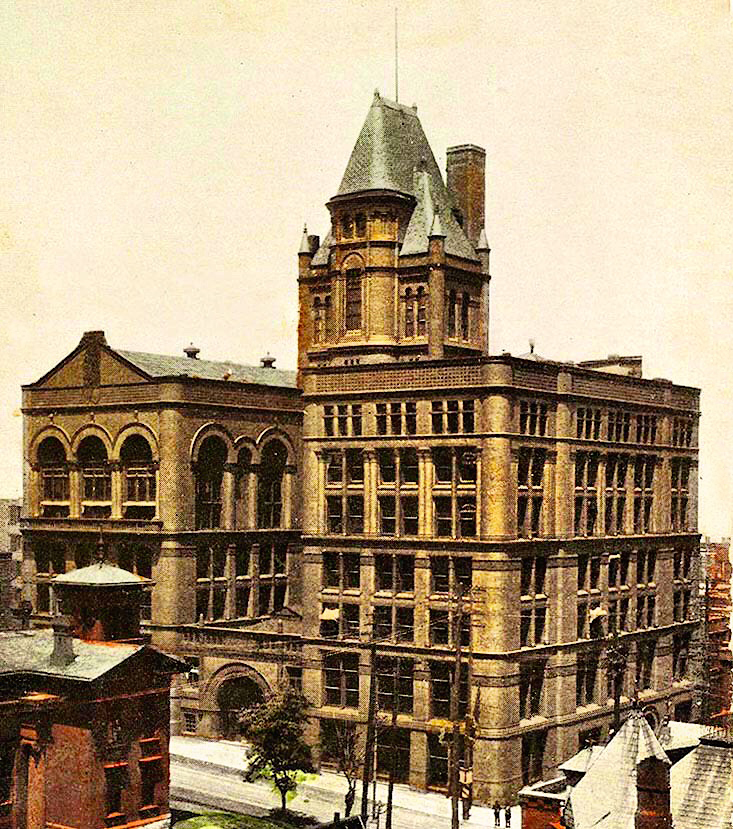
Kansas City Board of Trade


The price of wheat…

Beginning in the earliest years of the Twentieth Century, and carrying onward through 2013, from a trading pit in the heart of Kansas City, Missouri, the price of wheat, first, in the United States, then later, for countries the United States traded with, was influenced. Influenced by Kansas City traders. Traders who barked out “buy” and “sell” orders. Buy and sell orders correlated to futures contracts for Hard Red Winter Wheat.

Hard Red Winter Wheat futures contracts – the Kansas City Board of Trade.

Why was this exchange located Kansas City in the first place?

Soil and climate conditions in the Great Plains are perfect for growing wheat. So the trading operation for Hard Red Winter Wheat contracts was going to be based in the Midwest. 

Wheat requires specific conditions in order to grow. Ample sunlight. Well-drained soil. Sufficient water. One additional requirement needed – with Hard Red Winter Wheat – is, exposure to the cold. To each point, Kansas City’s neighboring state to the west is…ideal.

So…Kansas City?

In the late-19th Century, the, “Why Kansas City?” question had a lot to do with where the wheat the traders were trading was coming from – Kansas.
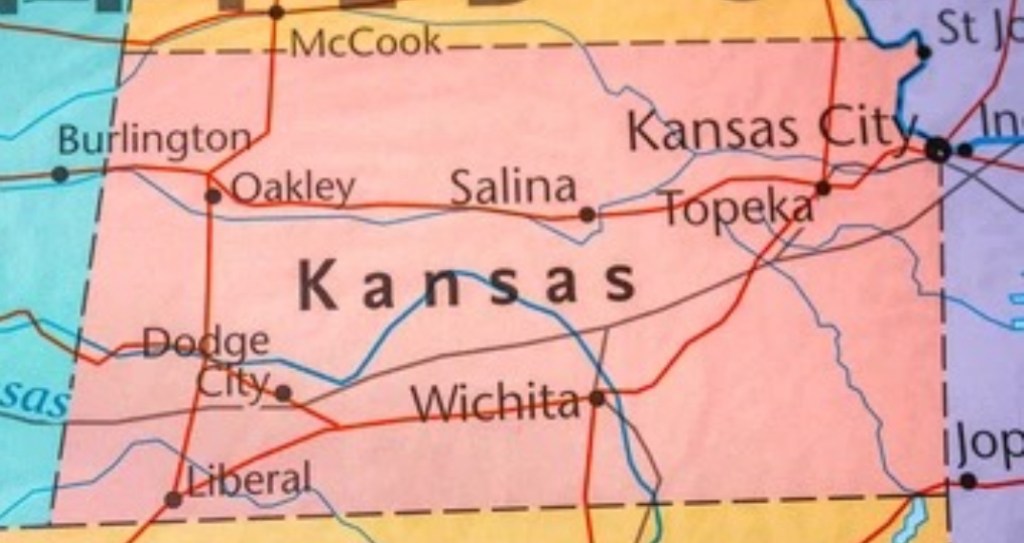

Known as the “Wheat State,” Kansas as a state -along with North Dakota – consistently leads the United States in wheat production. 

For example…

Last year, Kansas had 7,600,000 acres allocated to the planting of wheat. Coupled to 7,150,00 acres of harvested wheat. That was last year. And one of the things that I personally love most about my home state of Kansas is, Kansas just doesn’t radically swing, from whim to whim, all that much. Well, to be more precise, Kansas doesn’t really swing from whim to whim, at all. Which brings us to the question of, “Why Kansas City?” for the Hard Red Winter Wheat exchange.

While there were 7,150,000 harvested acres of Kansas wheat in 2024, 106 years prior – in 1918 – there were 7,250,000 harvested acres of wheat in Kansas. Pretty much the same acreage total. In 1918. And in 1924. 7,000,000 acres.

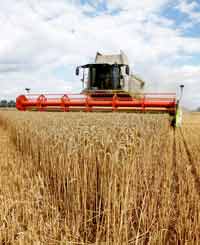
Step out of 1918 for a moment. And into 2024. While those small Kansas farm houses (and small Kansas farms) would no longer be. And while you will now see high-tech John Deere Combine Harvesters on those Kansas farms – complete with Wi-Fi…and a John Deere price tag, per Harvester, of between $700,000 and $1,000,000 – the “DNA” of the land from which Hard Red Winter Wheat had been harvested – and is still harvested today -pretty much, stayed the same. 

7,000,000 Kansas acres of harvested wheat in 1918. 7,000,000 Kansas acres of harvested wheat in 2024.

Logistically, an exchange for the trading of Hard Red Winter Wheat contracts -and, for that matter, for a board of trade – which was based in Kansas City, just made sense. Long, long ago. And today as well. Kansas City was (and is) the “big city” for Kansas farmers. Perfect for a Hard Red Winter Wheat exchange. 

The origin of the Kansas City Board of Trade traces back to its founding in the year 1856. Founded by a group of local merchants. Led by one Edward H. Allen.

Elected as the 10th mayor of Kansas City, Missouri, Edward H. Allen held the office in 1867 and 1868.

The idea for an exchange taking hold in Kansas City three years after Kansas City, Missouri itself was incorporated as a city. Which happened in 1853. 

The trading of Hard Red Winter Wheat contracts…

Just as the trading floor at the New York Stock Exchange in Manhattan is no longer a crowded hub of frantic traders, scurrying their trades about, those traders who once roamed the pit at the Kansas City Board of Trade – early in the Twentieth Century, and up through 2013 – have so too been replaced. By automation.

In 2012, the Kansas City Board of Trade was purchased by the CME Group – formerly, the Chicago Mercantile Exchange.
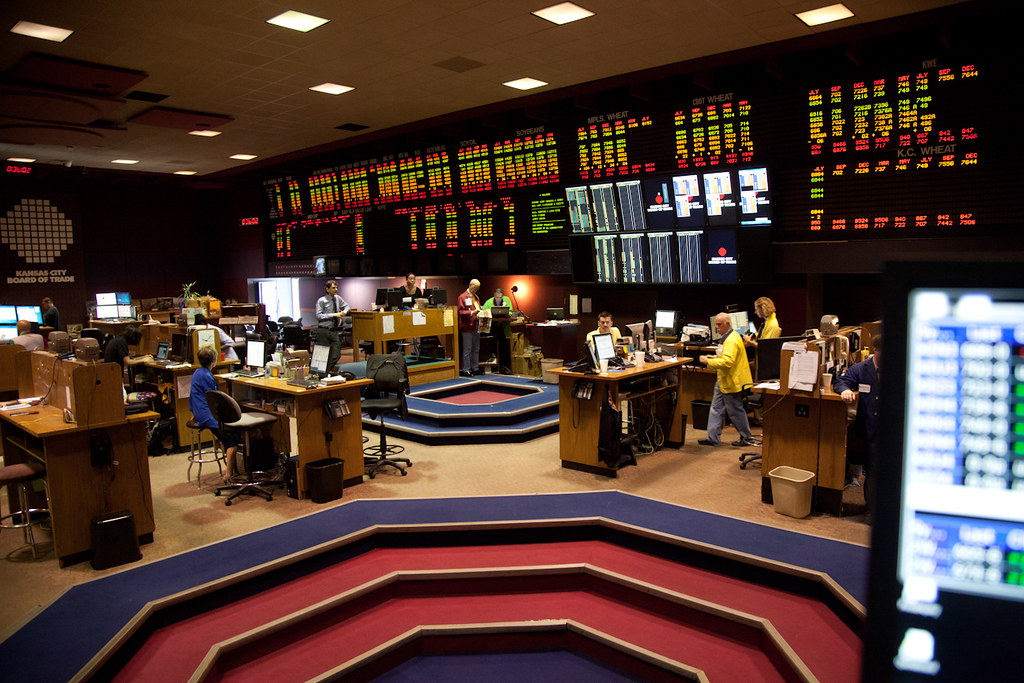

One year later, Kansas City’s trading floor – I.e.: the pit – was merged into the trading floor in Chicago. The trading of Hard Red Winter Wheat futures contracts on a Kansas City trading floor was no more. 
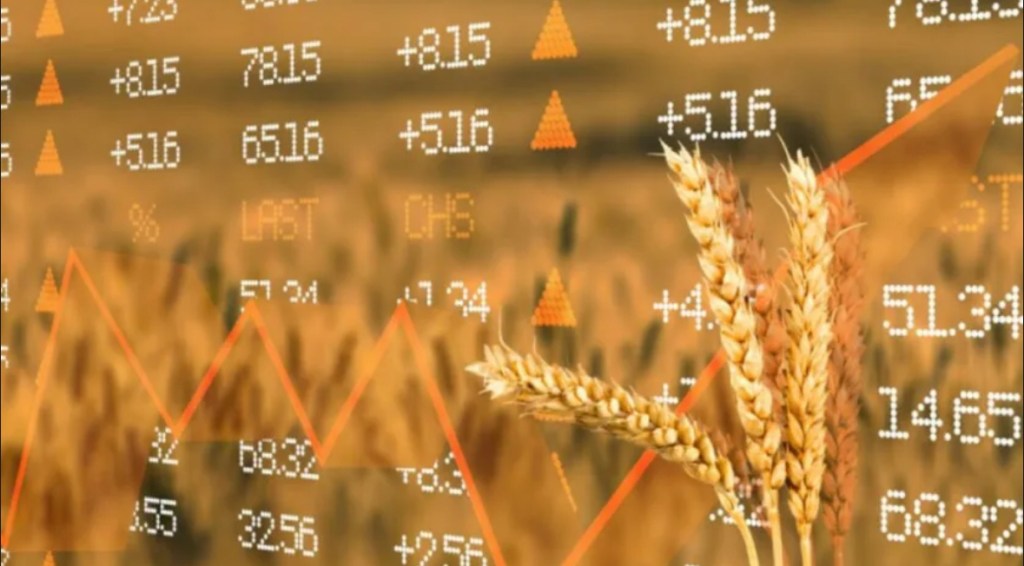

Two years later – in 2015 – CME’s trading floor itself was shut down. Replaced by automation. No pit in Kansas City. No pit in Chicago. The trading of Hard Red Winter Wheat futures contracts became… automated. 

While that old trading floor for Hard Red Winter Wheat in Kansas City – and those busy wheat traders in the pit – is no longer in operation, whenever you add cold cuts and mayonnaise to your sandwich, the price of the wheat – which makes up about 15% of the total cost of the bread you use to surround your cold cuts – is still set in Kansas City at the Kansas City Board of Trade.

In 2025, the Kansas City Board of Trade continues to function as the primary trading platform for Hard Red Winter Wheat futures contracts. Hard Red Winter Wheat futures contracts are a determinant in the price of wheat. Then too, in the price that we ultimately pay a loaf of bread.

Interestingly, the Kansas City Board of Trade had been Kansas City’s original chamber of commerce. So, the origin for the trading of Hard Red Winter Wheat contracts in Kansas City started off as – and in – a chamber of commerce. At 8th and Wyandotte. In Kansas City, Missouri. 

Local growers of Hard Red Winter Wheat. Local traders of Hard Red Winter Wheat. Local buyers of Hard Red Winter Wheat. 

While the local growers of Hard Red Winter wheat are still there – Kansas produces over 300 million bushels of wheat each year…equating to roughly 20% of total wheat production in the United States…there is not much else which is entirely “local” when it comes to the Kansas City Board of Trade. And Hard Red Winter Wheat. 

While 300 million bushels of Hard Red Winter Wheat is produced by 15,000 Kansas farmers each year. While the price of Hard Red Winter Wheat is set in Kansas City at the Kansas City Board of Trade. When it comes to the Kansas City Board of Trade – and Hard Red Winter Wheat – today, it would be wise to substitute the word “global” for “local.”
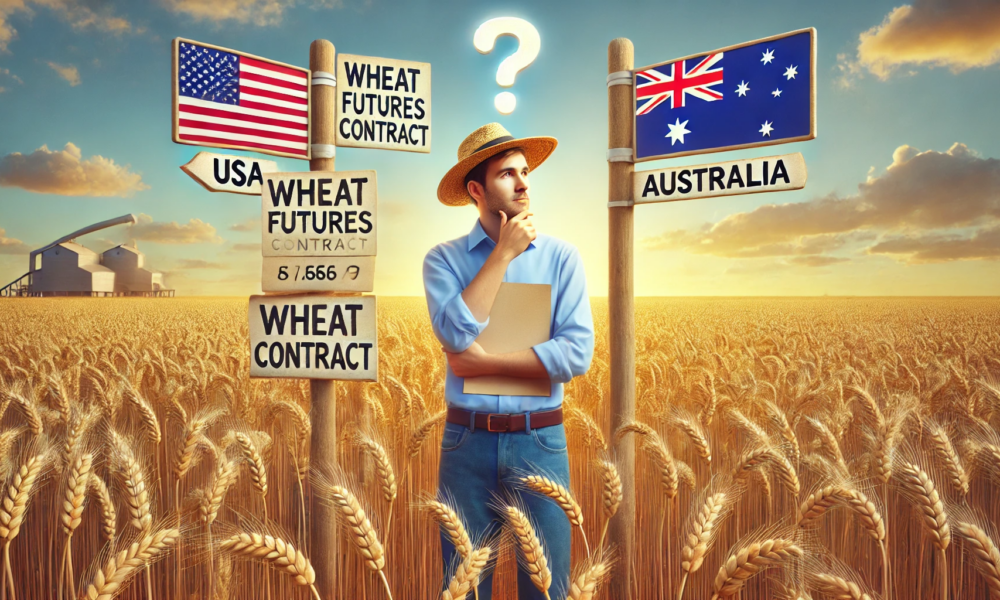

Local buyers of wheat? Kansas is an exporter. Each year, Kansas exports just about half of the 300 million bushels of Hard Red Winter Wheat harvested in the “Wheat State.”

As the world’s largest contiguous producer of winter wheat – that’s Kansas – having the price of Hard Red Winter Wheat still set in Kansas City is itself, poetic justice.

And establishing the exchange for the trading of wheat contracts in Kansas City – in the late stages of the 19th Century – turned out to be, rather fortuitous…

7,000,0000 acres of harvested wheat in Kansas in 1918. The price of Hard Red Winter Wheat set in Kansas City in 1918.

7,000,000 acres of harvested wheat in Kansas in 2024. The price of Hard Red Winter Wheat set in Kansas City in 2024.

Other than those $1,000,000 John Deere Combine Harvesters that you’ll see on Kansas farms in 2025 – coupled to the fact that Kansas, while a local grower, is really an international exporter – much, does look, feel and operate the same.

Acreage. Crop. Exchange. 1918. 2024. When in comes to American wheat, the more things change the more things stay the same – Kansas City.

The price of wheat in 1918…

The price of wheat in 2025…

The Kansas City Board of Trade.
The Kansas City Stockyards


In the late 1860’s, a young Illinois cattle dealer – Joseph “Cowboy” McCoy – had been scouting out locations. Cowboy McCoy was interested in an area along what became the Kansas Pacific rail line.


Cowboy McCoy was looking for the ideal setting. A destination point. Someplace Texas cattlemen could drive their cattle up north to before being sent on to Abilene, Kansas.

From Abilene, cattle would be shipped east. To Kansas City. Therein lies the origin for Kansas City’s emergence in the early Twentieth Century American cattle business.

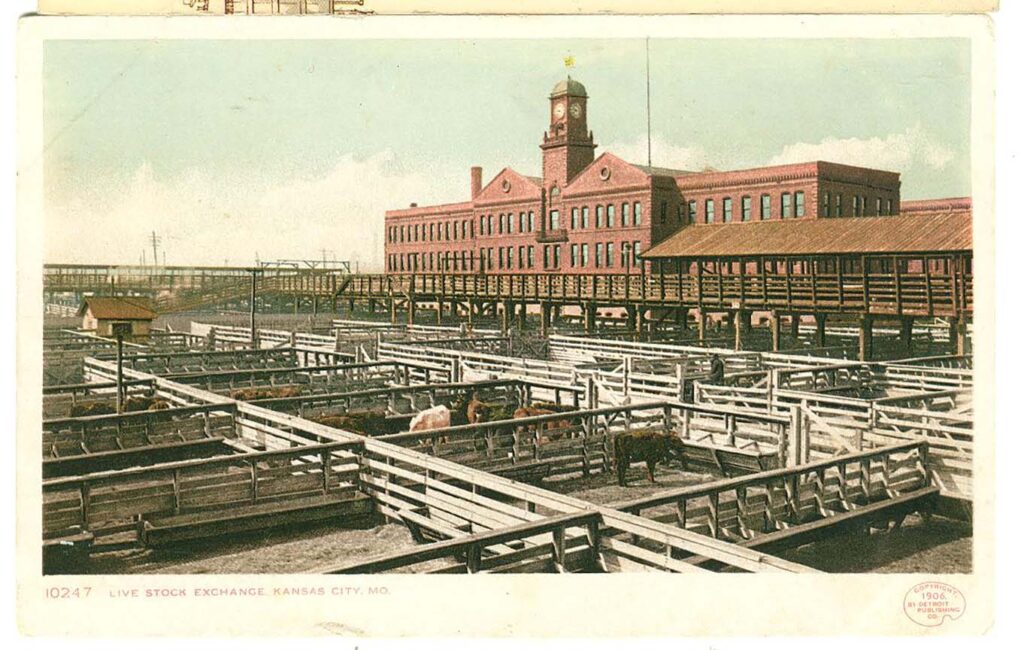
A few years after Cowboy McCoy settled in Abilene, Kansas City got their stockyards. Kansas City’s stockyards were located in a section of KC known as the West Bottoms. The birth of KC’s stockyards? 1871.

One: Cowboy McCoy. Two: Abilene. Three: The cattle business and Kansas City. Further writing, focused upon the latter. The two formers…mentioned as historical occurrences, relevant to the latter…

Ten years prior to KC getting their stockyards, Kansas City’s population had been about 4,000. By 1900, KC’s population grew to 160,000. Kansas City’s cattle industry was the driving force behind the city’s population growth.

Kansas City’s stockyards enabled livestock owners to transport their cattle to an exchange. At this newly-formed exchange in Kansas City, cattle could be sold to the highest bidders. Prior to the establishment of KC’s stockyards – and the exchange – livestock owners were only able to sell their cattle at whatever price railroad men offered to pay…limiting earning potential for cattle men. Kansas City’s stockyards – coupled to the establishment of the Kansas City Livestock Exchange – created a market for cattle men. The result? Higher cattle prices.

The Kansas City Livestock Exchange Building was constructed in 1911. At that time, the Kansas City Livestock Exchange Building was the largest livestock exchange building in the world.

The Exchange Building in Kansas City once housed over 400 offices. Telegraph offices. Beauty shops. Cattle tradesmen. Packing house buyers. Banks. All could be found in the Exchange Building in KC early in the 20th Century.

If you strolled through Kansas City’s stockyards early in the 20th Century, you could have found yourself in either Kansas or Missouri. The stockyards straddled both states.

KC’s stockyards were established in Kansas. Along the Kansas River. Two-thirds of KC’s stockyards were located in Kansas. The remainder of KC’s stockyards were located in Missouri.

By 1914, KC’s stockyards consisted of over 200 acres. Sixteen railroads converged in KC’s stockyards. The growth of the KC cattle trade – as well as the growth of the railroad – significantly contributed KC’s population growth. And to the growth of Kansas City’s economy. Kansas City’s first Union Station opened in the stockyards. In 1878.

By 1923, over 2.5 million head of cattle were shipped through KC’s stockyards. Local Kansas City packing houses were purchasing over 1 million heads of cattle per year. Only Chicago – Chicago’s Union Stockyards – was processing more cattle than KC. In fact, a world record was set in those KC Stockyards. In 1923. The record? One day’s receipts of cattle: 60,206 head

The maximum daily capacity of KC’s stockyards grew to nearly 200,000 head of cattle. Creating thousands of jobs. The KC stockyards were taking in cattle from 35 states. Shipping cattle off to 42 states. Plus Canada. Hence, Kansas City’s nickname – Cowtown.

In KC’s West Bottoms, where the stockyards were once located, where the cattle industry once thrived, today, you won’t find any cows.

Today in the West Bottoms, Flaherty and Collins’ Stockyards Place is a beautiful 21st Century Midwest collection of condominiums. Luxury living. A trendy urban lifestyle. A bike trail which runs alongside the Kansas River. No cows.

KC’s stockyards processed their last head of cattle in 1991. In October of 1991, KC’s stockyards were closed for good. No more packing house buyers.

Today, a different form of buyers can be found where the KC stockyards once were. This new form of buyers? They’re Kansas City professionals. KC professionals who are shopping for a new condo. Buyers? Yes. Packing house buyers? No.

The Livestock Exchange in Kansas City was located on Gennessee Street. Just a stone’s throw away from that old exchange on Gennessee Street, today you’ll find Stockyards Place. Luxury living. Walking distance to wineries. To galleries. No cattle pens. No feedlots. No cows.


Marlboro Township

The name – Marlboro Township – can be traced back to what had been a local discovery…a discovery which occurred, nearly three hundred years ago.

This local Marlboro discovery, then too, the utilization of what had been discovered nearly three-hundred years ago alongside what is now Marlboro Township, was a mineral. That mineral – emerging to go on to become quite important to the local agricultural industry – being this region’s marl. 


Marl is a mineral which, by the late 18th century in New Jersey, was relied upon first, by local farmers who owned farms in what would go on to become Marlboro Township. Then, later, by farmers farming farmland situated throughout New Jersey. Then, later, by farmers farming farmland well beyond – and outside of – New Jersey.

In Monmouth County New Jersey, marl was discovered in 1768. East of where the township lines for what we now call Marlboro Township can be found. A true farmer’s ally, the functionality of marl as a mineral can be seen in how marl – composed of the remains of prehistoric fish – was able to be spread over topsoil of area farmland during the winter months. Then tilled into the farmland soil in the spring. Farmers, in what we now know to be Marlboro Township, came to rely upon marl as the means through which they could improve their soil’s fertility.

Marl is not exclusive to New Jersey, by any means. The recognized use of marl goes way, way, way back. To the 1st century. 

Marl is a de-facto natural fertilizer. A natural fertilizer which had been found to exist in the grounds underneath Marlboro Township in the 18th Century. Long, long, long before the comeuppance of any commercial fertilizer industry in New Jersey would have been able to supply local New Jersey farmers with a finished fertilizer product which could be used for their farms.

Harvested in what would later go on to become Marlboro Township, the region’s marl – once the marl had been harvested – would go on to evolve as an industry. Later, to be transported by rail. On to nearby agricultural markets. New Jersey’s local discovery of marl established an industry early on for Marlboro Township.  

By the mid-19th Century, the transportation of New Jersey marl was key to facilitating commerce. For the local harvesters of marl. For the local “exporters” of this marl. And for the farmers and the farms which came to rely upon – and use – marl as fertilizer. 

To that effect – relating to marl, as a local industry…and to the transportation of marl as well – in 1853, the Freehold and Jamesburg Agricultural Railroad was founded in Jamesburg, New Jersey. Founded, primarily to facilitate the transportation – by rail – of this newly-identified regional mineral.

The Freehold and Jamesburg Agricultural Railroad operated along a 27-mile rail line.  Connecting the locally-harvested marl – in what is now Marlboro Township – to nearby agricultural markets. Among them, Freehold, Jamesburg, Monroe, Manalapan and Englishtown.  


For comments about this article, or to offer suggestions and ideas for further pieces written about Marlboro Township, kindly reach out to the author, Ted Ihde.

phone: (816) 699-6804

email: authortedihde@gmail.com