Kansas City… Kansas City, Missouri. Kansas City, Kansas.
There had been a few different beginnings for what we now know to be Kansas City. The very first one?
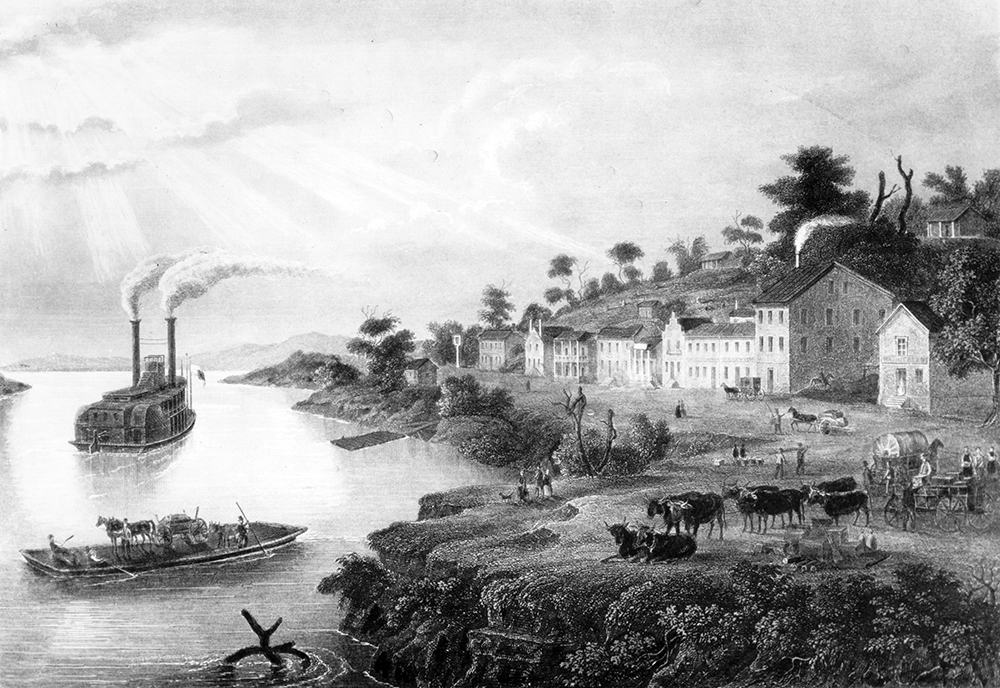
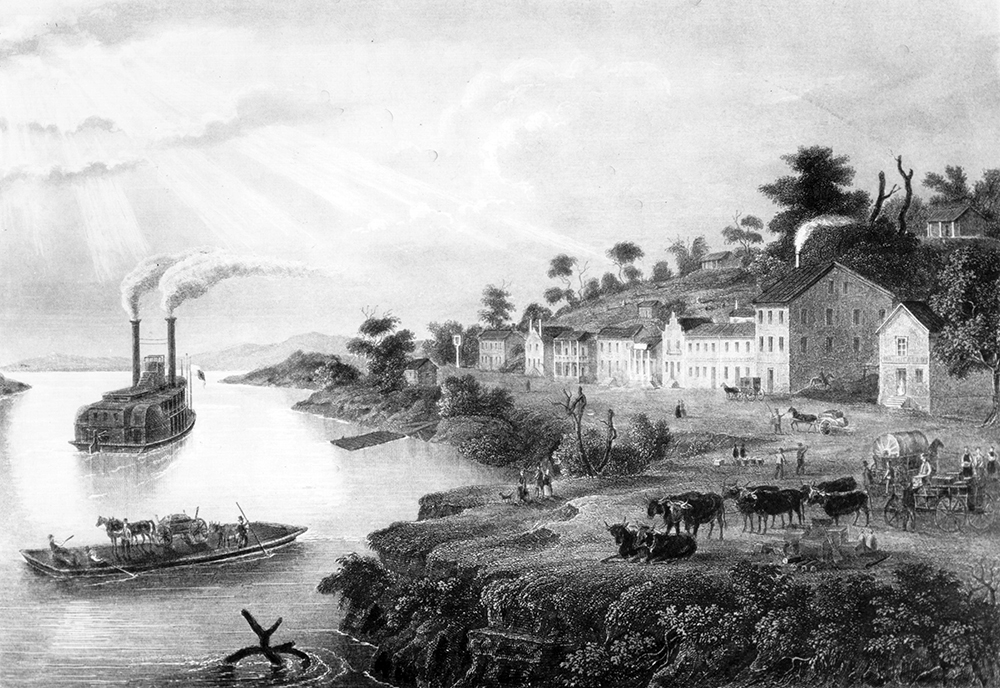
In the 1830s, we had the first one – Westport Landing.
Westport Landing was established on a section of 257 acres which would evolve into what would become Kansas City, Missouri.
The 257 acres had been sold by the federal government to a man of French ancestry…Gabriel Prudhomme. This land sale took place in 1831.
Whereas the land Gabriel Prudhomme purchased from the federal government would go on to become Kansas City, Missouri, Westport Landing was the early, pre-Kansas City, Kansas City development.
Westport Landing – strategically set up alongside the heavily-trafficked Santa Fe Trail – was an unincorporated collection of merchants. These were merchants who established their businesses in Westport Landing to provide Santa Fe Trail travelers with supplies.
The merchants were inland. And the Westport Landing merchants figured out they could reduce their costs by receiving supplies by way of the Missouri River. Rather than by land. And they did.
The waterway entry point at which Westport Landing merchants were able to receive supplies shipped to them on the Missouri River was located where what is now Grand Boulevard in Kansas City, Missouri intersects with the Missouri River. And it is at this intersection – where Grand Boulevard meets the “Big Muddy” – where we found Westport Landing.
Twenty years later – in 1850 – Westport Landing was incorporated as the Town of Kansas.
Three years after that – in 1853 – the Town of Kansas was reincorporated and renamed. The new name for the Town of Kansas? The City of Kansas. And this renaming – as the City of Kansas – took place eight years before the State of Kansas became the 34th state of the United States. In 1861.
In 1889, the name for the city – the City of Kansas – was changed. Changed to Kansas City. The very, very first Kansas City – that first Kansas City being, Westport – was annexed by Kansas City, Missouri eight years later. In 1897.
All the while, on the other side of the Missouri River – in the new Kansas Territory – small Kansas settlements were forming. And growing. Growing into small Kansas towns.
In 1872, a consortium of small Kansas towns – on the other side of the river – merged. And incorporated. Therein – in 1872 – we have the origin for Kansas City, Kansas.
Wherein the larger Kansas City – and the older Kansas City, too – is the one which is located in Missouri, and not in Kansas, the “Kansas” in Kansas City is not derived from the State of Kansas.
The name of the city – Kansas City, Missouri – was named after a river. Not a state. Not Kansas. That river being…the Kanza River.
The Kanza River would go on to become the Kansas River. The Kansas River provided the name – “Kansas” – for the city – Kansas City, Missouri.
So the city – Kansas City – which originally formed as Westport Landing, which would later go on to become the Town of Kansas, which would later go on to become the City of Kansas, which would later go on to become Kansas City…does not derive its name from its neighbor to the west – the State of Kansas.
Kansas City… Kansas City, Missouri. Kansas City, Kansas.
There had been a few different beginnings for what we now know to be Kansas City. The very first one?
In the 1830s, we had the first one – Westport Landing.
Westport Landing was established on a section of 257 acres which would evolve into what would become Kansas City, Missouri.
The 257 acres had been sold by the federal government to a man of French ancestry…Gabriel Prudhomme. This land sale took place in 1831.
Whereas the land Gabriel Prudhomme purchased from the federal government would go on to become Kansas City, Missouri, Westport Landing was the early, pre-Kansas City, Kansas City development.
Westport Landing – strategically set up alongside the heavily-trafficked Santa Fe Trail – was an unincorporated collection of merchants. These were merchants who established their businesses in Westport Landing to provide Santa Fe Trail travelers with supplies.
The merchants were inland. And the Westport Landing merchants figured out they could reduce their costs by receiving supplies by way of the Missouri River. Rather than by land. And they did.
The waterway entry point at which Westport Landing merchants were able to receive supplies shipped to them on the Missouri River was located where what is now Grand Boulevard in Kansas City, Missouri intersects with the Missouri River. And it is at this intersection – where Grand Boulevard meets the “Big Muddy” – where we found Westport Landing.
Twenty years later – in 1850 – Westport Landing was incorporated as the Town of Kansas.
Three years after that – in 1853 – the Town of Kansas was reincorporated and renamed. The new name for the Town of Kansas? The City of Kansas. And this renaming – as the City of Kansas – took place eight years before the State of Kansas became the 34th state of the United States. In 1861.
In 1889, the name for the city – the City of Kansas – was changed. Changed to Kansas City. The very, very first Kansas City – that first Kansas City being, Westport – was annexed by Kansas City, Missouri eight years later. In 1897.
All the while, on the other side of the Missouri River – in the new Kansas Territory – small Kansas settlements were forming. And growing. Growing into small Kansas towns.
In 1872, a consortium of small Kansas towns – on the other side of the river – merged. And incorporated. Therein – in 1872 – we have the origin for Kansas City, Kansas.
Wherein the larger Kansas City – and the older Kansas City, too – is the one which is located in Missouri, and not in Kansas, the “Kansas” in Kansas City is not derived from the State of Kansas.
The name of the city – Kansas City, Missouri – was named after a river. Not a state. Not Kansas. That river being…the Kanza River.
The Kanza River would go on to become the Kansas River. The Kansas River provided the name – “Kansas” – for the city – Kansas City, Missouri.
And Kansas
So the city – Kansas City – which originally formed as Westport Landing, which would later go on to become the Town of Kansas, which would later go on to become the City of Kansas, which would later go on to become Kansas City…does not derive its name from its neighbor to the west – the State of Kansas.
When you are considering whether to pursue a real estate development project, reaching out to local government officials regarding the availability of tax incremental financing is one step you can take.
Tax incremental financing – TIF –is a development subsidy whereby the municipality diverts future property tax revenue towards economic development. The origin of tax incremental financing traces back to the State of California. And to 1952.
In order to establish a TIF subsidy, an urban renewal district – a TIF district – is first drawn up by the municipality.
With tax incremental financing, the municipality will be diverting increases in property taxes within the urban renewal district from the municipality, to development. It’s a subsidy. With a lifespan of twenty or twenty-five years.
The foundation for TIF? Development leads to increases in property values within the TIF district. As well as in surrounding neighborhoods. The theory? Increasing property values, which lead to an increase in property tax receipts collected by the municipality, offset TIF subsidies.
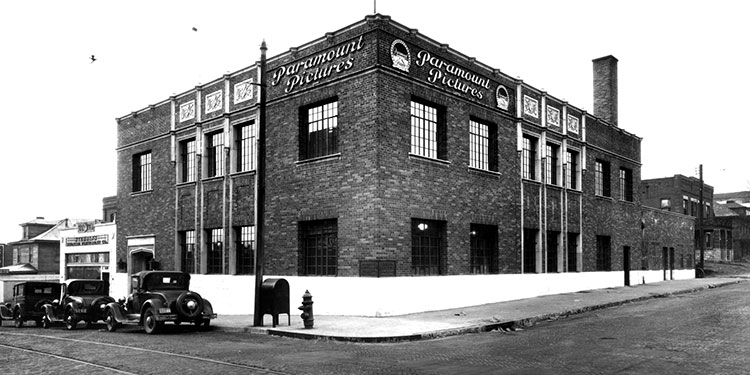
A film row is a collection of film studio offices which are located next to each other. Film rows functioned as motion picture industry sales hubs and fulfillment centers. Film rows also played host to meetings and events.
From the 1920’s and on through the 1970’s, Hollywood used film rows to produce and distribute content.
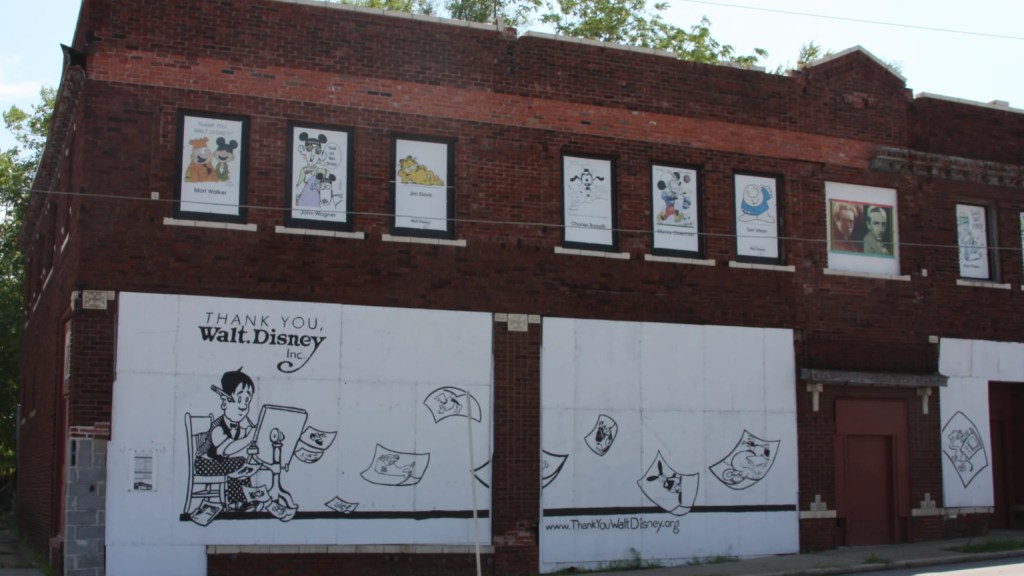
Kansas City’s Old Film Row was located in what is today Crossroads Arts District – 17 buildings within a four block radius. Most of those buildings are still there.
Columbia Pictures and Paramount had offices between Central and Wyandotte on 18th Street.
Where 17th Street intersects with Wyandotte, Warner Brothers and Universal Studios were across the street from one another. 1700 Wyandotte had been Universal Studios’ Midwest storage and distribution center.
United Artists had an office on the corner of Central and 18th Street.
Walt Disney Company was located on 18th Street…just off Wyandotte.
Disney evolved out of Laugh-O-Gram Studio. Laugh-O-Gram started out in the McConahay Building – 1127 East 31st Street.
The MGM building – built in 1930 – was at 220 West 18th Street.
National Screen Service – 18th Street and Baltimore – was one of the largest distributors of movie posters, accessories and print ads.
Screenland Café – Wyandotte and 18th Street – had two screening rooms as well as two theatre circuits. Those two theatre circuits would evolve into AMC Theaters.
AMC was founded in 1920 in KC by Maurice, Edward and Barney Dubinsky. The Durbinsky’s would go on to change their name. From Dubinsky to Durwood.
Prior to AMC, the Durwood’s had Durwood Theatres. Durwood Theatres started out on Baltimore Street. In Old Film Row.
Marquette is a charming Kansas town located in McPherson County. Marquette is home to the Kansas Motorcycle Museum.
By 1890, the population of Marquette was 367. Today, Marquette’s population is fewer than 1,000.
Marquette is one of a handful of Kansas municipalities where a future homeowner who chooses to relocate to Marquette could acquire a residential lot for their new home build through Kansas’s homesteading provision.
Residential lots in Marquette’s homesteading program have ranged from between 11,000 to 25,000 square feet.
Lincoln is a quaint Kansas town located in Lincoln County. Lincoln in home to Crispins Drug Store Museum.
Lincoln was settled in 1870. By 1880, Lincoln’s population was 400. In 2020, the population of Lincoln was fewer than 1,500.
In Lincoln, free land (with conditions) has been able to be conveyed to Kansas homesteaders through Lincoln’s homesteading program. The homesteaded land in Lincoln has been able to be conveyed with the condition that the homesteader builds – and lives in – a new single-family home on their homesteaded lot.
Residential lots in Lincoln’s homesteading program have ranged from between 14,000 to 35,000 square feet.
Homesteading in Marquette and Lincoln is accompanied by conditions homesteaders are required to meet.
In Lincoln, a homesteader is required to build – and live in – their new single-family home. Also, a new home built in Lincoln on a homesteaded lot is required to have a minimum of 1,300 square feet of living area.
Prior to the U.S. government’s entrance into the home loan business in the 1930’s – this coming as a result of FDR’s New Deal – savings and loan associations had, up until that point, provided the majority of the loans which were used to finance the acquisition of homes.
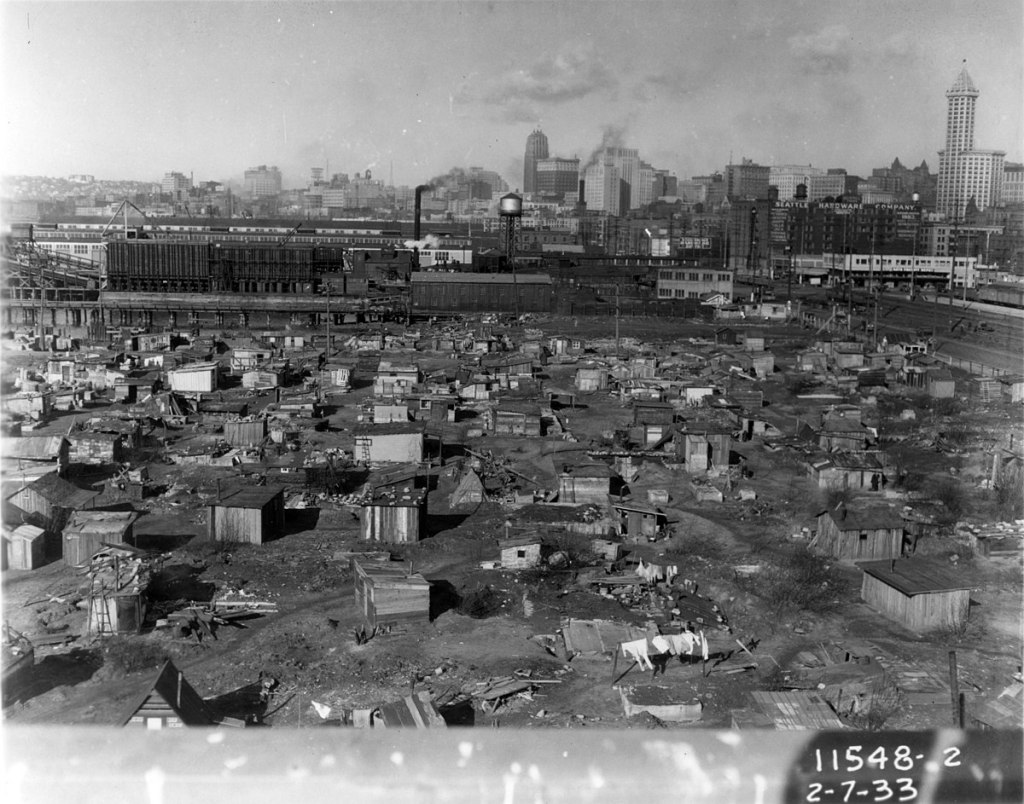
The Homeowners Refinancing Act and the Home Owners Loan Corporation Act were each passed in 1933…just as the Great Depression was devastating the finances of Americans. These two housing Acts? Extensions by the U.S. government into the private sector. One byproduct of FDR’s New Deal.
The Home Refinancing Act and the Home Owners Loan Corporation Act provided assistance to Americans who were in danger of losing their homes. Due to an inability to refinance their home loans. Thanks to the New Deal, Americans gained access to new refinancing opportunities. Which, should there have been no New Deal, would not have been in place. The government’s election to get more deeply involved in the home loan business during the Great Depression was a wise foray by the U.S. government into the private sector.
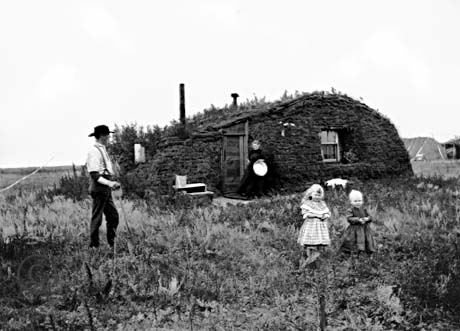
Rewind to 300 years before the New Deal. Rewind to the earliest days of settlers moving west into new territories of what would in time become the United States.
Whereas FDR’s New Deal took aim at stabilizing a teetering U.S. housing market during the Great Depression, for early settlers, there wasn’t a need for government assistance in regard to real estate. There were no government programs in place to assist early settlers. There was no U.S. government to provide such government assistance.
During the 17th Century, there were no American institutional resources – nor government programs – which could facilitate real estate transactions. Was there interest during the 17th Century in acquiring land? Yes. Was there a banking industry? Was there a mortgage industry? Were there government programs in place which could be relied upon to help finance real estate transactions? No. No. And…no.
During the 17th Century, land acquired by settlers who moved west…those land acquisitions would not be categorized as real estate sales. Nor was acquired land financed through the use of mortgages. No, in the 17th Century, those who aspired to own their own land in this vast, new territory ventured out west. They found a piece of land. They claimed the land. Land ownership without a deed. Without a mortgage. Without government oversight.
At that time, there was not a lot of “demand” for this land. Though the natives who long inhabited this land, pre-settlement, would beg to differ. There was no formal market established, through which land could be bought and sold. Nobody was entering into real estate contracts when they acquired their land. No sellers, as we would categorize sellers today. No buyers, as we would categorize buyers today.
Land acquisition – by way of financing the land acquired – was not the practice. Claiming unsettled land was the practice. No real estate contracts. No mortgages. No deeds. Interesting how, 300 years later, the U.S. government’s role in the home loan business would become so pronounced. So important. Interesting how the U.S. government evolved into a stakeholder in the business of financing real estate. This role for government occurred, largely, through FDR’s New Deal.
Government’s intervention in the home loan business? That was during the 1930’s. Government’s complete absence from the process of acquiring land? That would have been during the aforementioned 17th Century. How about vehicles used to finance the purchase of real estate, relevant to protections found within FDR’s New Deal? That would be banks.
Six years after Henry Duncan established the first savings bank in England in 1810, the first saving bank was organized in the United States. In Philadelphia. That bank was the Philadelphia Saving Fund Society – the very first American savings bank.
Philadelphia Saving Fund Society opened in Philadelphia in 1816…established by a group of investors headed by War of 1812 veteran – and Philadelphia native – Condy Raquet.
Bank takeovers, bank mergers, bank acquisitions… What once had been the Philadelphia Saving Fund Society is now part of Citizens Bank of Pennsylvania.
Whereas Philadelphia is home to the first American savings bank, Philadelphia is also home to the first commercial bank established in the United States.
Thirty-four years prior to the establishment of America’s first savings bank – Philadelphia Saving Fund Society, formed in 1816 – we have the first United States commercial bank. Also founded in Philadelphia. That year would be 1781. The bank? That bank was Bank of North America.
Bank of North America was the first chartered bank – the first commercial bank – organized in the United States. Bank of North America…the formation for which emanated from an idea shared by two early American forefathers. Those two forefathers? Alexander Hamilton and Henry Morris.
Hamilton and Morris set up their bank to function as an informal American central bank. Their idea for the bank being, to provide financing to the United States government. Though constructed with the goal for their bank to operate as a de-facto, unofficial United States central bank, Bank of North America instead became a traditional state chartered bank. Not the central bank it was envisioned to become. Bank of North America was never the government financing tool Hamilton and Morris envisioned the bank to be. Rather, Bank of North America provided home loans to Philadelphians.
Bank takeovers, bank mergers, bank acquisitions… Bank of North America is now part of Wells Fargo.
During the 1800’s, loans used by Americans to finance real estate were not mirror images of the loans Americans use to finance homes in 2024.
During the 19th Century, home loan payment schedules were much shorter. No 30-year amortization. No 15-year amortization. Rather, in the 19th Century, you’d likely have either a 5-year or a 6-year loan payment schedule. No 15-year amortization. No 30-year amortization.
During the 19th Century, balloon mortgages were common. With a 5-year mortgage or a 6-year mortgage, qualifying for the home loan was difficult. And, in many cases, those 5-year or 6-year mortgages were balloon mortgages.
19th Century balloon mortgages were often structured with interest-only payments. After the mortgagor made their payments for the five or six years, the loan would then “balloon.” Whereby, the mortgagor would at that time be required to pay off their loan in full.
Coupled to interest-only payments – with the balloon provision – 19th Century mortgages would oftentimes be accompanied by low loan-to-values. In the range of a 50% loan-to-value. With interest-only payments made for 5 or 6 years, loan payoffs for mortgagors after the 5 or 6 years would have remained at payoff amounts equal to 50% of the purchase price of the property. Not taking into account any potential property appreciation. No New Deal. No government assistance available. Difficult to pay off and/or refinance home loans at that time…
In the midst of the Great Depression, upwards of 40% of all home mortgages in the United States were in default. Hence, FDR’s New Deal…
No government regulation for those early land acquisitions out west. No government regulation when those home loans were interest-only, coupled to balloon provisions. Rationale behind some form of a “new deal”…maybe?
Through the FHA, longer loan terms became available. 20-year mortgages. 30-year mortgages. Amortized. Unlike earlier interest-only mortgages, through FDR’s government reach into the real estate sector, mortgagors would be paying down their home loan principal balances. Through each and every payment they made.
The 1934 National Housing Act was signed into law by President Franklin Delano Roosevelt on June 27, 1934. The 1934 National Housing Act fundamentally changed government’s role in housing.
The United States Housing Act of 1937 – the Wagner-Steagall Housing Act – established the Federal Housing Administration (the FHA). The FHA was created to handle mortgage insurance. Mortgage insurance allowed for amortized mortgages…coupled to regular monthly payments.
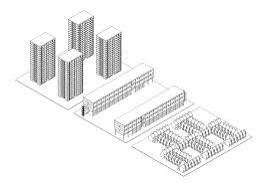
Density bonus programs are developer incentives. They function as “build catalysts.” Catalysts which make it worthwhile – and economically feasible – for developers to undertake the construction of inclusionary housing projects. In summary, a density bonus program permits an increase in allowed dwelling units per acre – DU/A.
Here is how a density bonus program works…
Density bonuses enable developers to build in excess of a site’s base zoning. In exchange for the municipality permitting a developer to build unit totals which exceed standard allowances, the developer is required to designate a set number of units built as income-restricted affordable housing.
Density bonus programs are enacted through local ordinances. Ordinances amend zoning codes. The process of having zoning codes amended, through ordinances, accompanies the implementation of density bonus programs. This is so because standard zoning codes – prior to the codes being amended – would not authorize the developer’s proposed build, if not amended. The intended outcome? Construction of more affordable housing units.
Density bonus programs establish developer thresholds. Once the threshold is met by the developer, the developer qualifies for the density bonus.
Typically, density bonus programs allow for increases of between 10% and 20% over baseline permitted density. This, in exchange for the developer’s commitment to the provision of a pre-set number of affordable housing units.
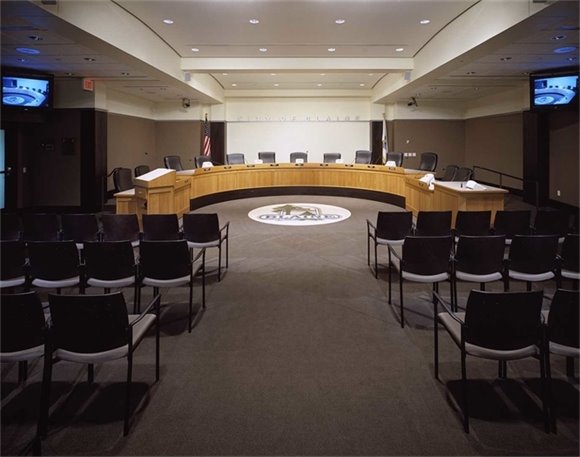
Since the 1920’s, Kansas City, Missouri has utilized the council-manager form of government. Phoenix is the largest American city which utilizes the council-manager form of government.
In a council-manager form of government, city council charts how the city functions. An analogy…
In a council-manager form of government, city council could be looked at as being comparable to a corporate board of directors. The council-manager form of government, through its construct, looks somewhat like corporate governance. Using the corporate analogy, a city manager would be the city’s “executive officer.” The city’s “CEO.” The city manager, which is an unelected position, is hired by the city.
The city manager works, in theory (ideally) outside of the scope of the political arena. The city manager executes policy. The city manager implements ordinances…ordinances passed by, using our corporate analogy once again, the city’s “board of directors.” The “board of directors” being…city council.
The city’s “CEO?” City manager. The city’s “board of directors?” City council.
Under the council-manager form of government, the mayor is an elected public official. Elected by voters.
The city manager operates behind the-scenes. Running the city’s day-to-day operations. The mayoral position is a more visible position. Interviews? Newspaper articles? Mayor.
As executive officer, the city manager is responsible for oversight of city departments. The city manager collaborates with the mayor – and with city council – to enact policy. City policy? That policy emanates from city council.
City planning? City programs? The city budget? These are responsibilities of the city manager.
The position of mayor is a political position. The city manager position is apolitical.
City managers are not out campaigning alongside candidates who are running for public office. The city manager does not publicly promote the interests of Democrats, nor of Republicans.
Campaigning? Part of what it takes to become mayor. Politics? Goes hand-in hand with winning an election and becoming mayor.
Photo ops? Fundraising? TV appearances? Mayor. The city manager may very well attend these events as well. Yet it will be the mayor – moreso than the city manager – who is more likely to show up and make an appearance.
In the late 1860’s, a young Illinois cattle dealer – Joseph “Cowboy” McCoy – had been scouting out locations. Cowboy McCoy was interested in an area along what became the Kansas Pacific rail line.
Cowboy McCoy was looking for the ideal setting. A destination point. Someplace Texas cattlemen could drive their cattle up north to before being sent on to Abilene, Kansas.
From Abilene, cattle would be shipped east. To Kansas City. Therein lies the origin for Kansas City’s emergence in the early Twentieth Century American cattle business.
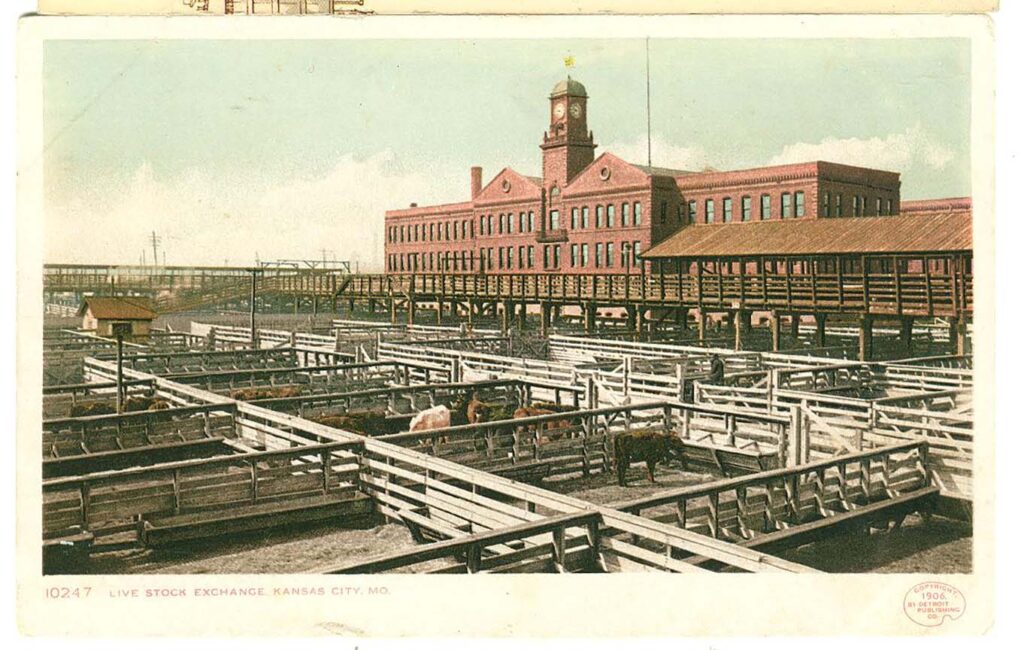
A few years after Cowboy McCoy settled in Abilene, Kansas City got their stockyards. Kansas City’s stockyards were located in a section of KC known as the West Bottoms. The birth of KC’s stockyards? 1871.
One: Cowboy McCoy. Two: Abilene. Three: The cattle business and Kansas City. Further writing, focused upon the latter. The two formers…mentioned as historical occurrences, relevant to the latter…
Ten years prior to KC getting their stockyards, Kansas City’s population had been about 4,000. By 1900, KC’s population grew to 160,000. Kansas City’s cattle industry was the driving force behind the city’s population growth.
Kansas City’s stockyards enabled livestock owners to transport their cattle to an exchange. At this newly-formed exchange in Kansas City, cattle could be sold to the highest bidders. Prior to the establishment of KC’s stockyards – and the exchange – livestock owners were only able to sell their cattle at whatever price railroad men offered to pay…limiting earning potential for cattle men. Kansas City’s stockyards – coupled to the establishment of the Kansas City Livestock Exchange – created a market for cattle men. The result? Higher cattle prices.
The Kansas City Livestock Exchange Building was constructed in 1911. At that time, the Kansas City Livestock Exchange Building was the largest livestock exchange building in the world.
The Exchange Building in Kansas City once housed over 400 offices. Telegraph offices. Beauty shops. Cattle tradesmen. Packing house buyers. Banks. All could be found in the Exchange Building in KC early in the 20th Century.
If you strolled through Kansas City’s stockyards early in the 20th Century, you could have found yourself in either Kansas or Missouri. The stockyards straddled both states.
KC’s stockyards were established in Kansas. Along the Kansas River. Two-thirds of KC’s stockyards were located in Kansas. The remainder of KC’s stockyards were located in Missouri.
By 1914, KC’s stockyards consisted of over 200 acres. Sixteen railroads converged in KC’s stockyards. The growth of the KC cattle trade – as well as the growth of the railroad – significantly contributed KC’s population growth. And to the growth of Kansas City’s economy. Kansas City’s first Union Station opened in the stockyards. In 1878.
By 1923, over 2.5 million head of cattle were shipped through KC’s stockyards. Local Kansas City packing houses were purchasing over 1 million heads of cattle per year. Only Chicago – Chicago’s Union Stockyards – was processing more cattle than KC. In fact, a world record was set in those KC Stockyards. In 1923. The record? One day’s receipts of cattle: 60,206 head
The maximum daily capacity of KC’s stockyards grew to nearly 200,000 head of cattle. Creating thousands of jobs. The KC stockyards were taking in cattle from 35 states. Shipping cattle off to 42 states. Plus Canada. Hence, Kansas City’s nickname – Cowtown.
In KC’s West Bottoms, where the stockyards were once located, where the cattle industry once thrived, today, you won’t find any cows.
Today in the West Bottoms, Flaherty and Collins’ Stockyards Place is a beautiful 21st Century Midwest collection of condominiums. Luxury living. A trendy urban lifestyle. A bike trail which runs alongside the Kansas River. No cows.
KC’s stockyards processed their last head of cattle in 1991. In October of 1991, KC’s stockyards were closed for good. No more packing house buyers.
Today, a different form of buyers can be found where the KC stockyards once were. This new form of buyers? They’re Kansas City professionals. KC professionals who are shopping for a new condo. Buyers? Yes. Packing house buyers? No.
The Livestock Exchange in Kansas City was located on Gennessee Street. Just a stone’s throw away from that old exchange on Gennessee Street, today you’ll find Stockyards Place. Luxury living. Walking distance to wineries. To galleries. No cattle pens. No feedlots. No cows.
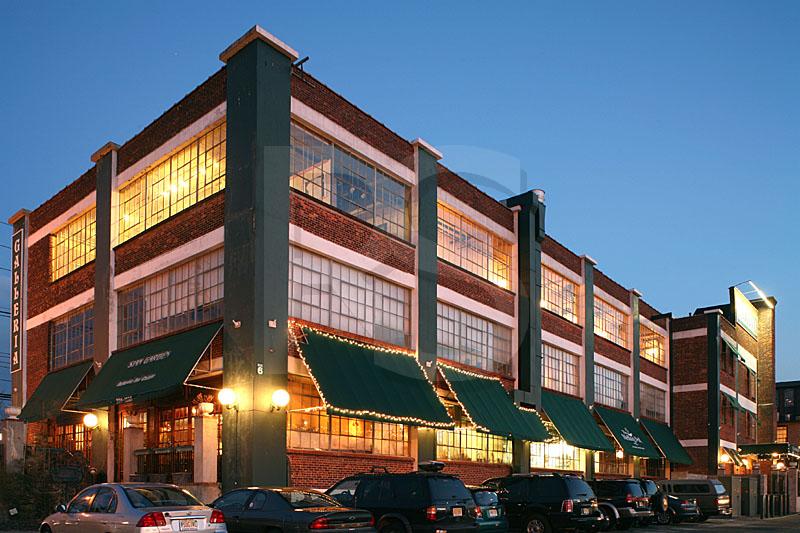
Nestled cozily in the heart of Red Bank, New Jersey, today, one will find The Galleria. The Galleria Red Bank. A quaint collection of offices, restaurants and boutiques. Found in “New Jersey’s Greenwich Village.” It took 10 years to build that Galleria…early in the Twentieth Century. And it wasn’t called The Galleria, at that time.
Between 1907 and 1917, The Galleria – originally known as The Eisner Building – was constructed with a specific endgame in mind. And that early Twentieth Century endgame for The Eisner Building was not thought up with similar planning to how The Galleria is utilized today.
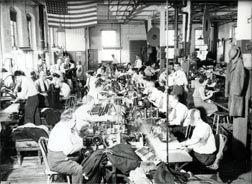
The Galleria today? It’s a repurposed Red Bank centerpiece. Located where Bridge Avenue meets West Front Street. The original plan for The Galleria? For The Eisner Building? That original plan didn’t include any restaurants. Nor did that original plan include any retail outlets. Rather, that original plan for The Eisner Building was…textiles. A textile factory.
During World War I and World War II, The Eisner Building was a Red Bank stalwart…though not one which espoused trendy retail “DNA.” Rather, during both World Wars, The Eisner Building possessed quite a different industrial “DNA.” It functioned as a supply chain for American military equipment. Flight suits, military uniforms, gas masks. Wartime supplies. This was the original “DNA” for what is today The Galleria. The wartime purpose for The Eisner Building extended on through both World Wars. Manufacturing. Supplies for American soldiers. This was The Galleria – I.e.: then, The Eisner Building – in the early-to-mid Twentieth Century.
Today, there are eight retail outlets located in the once-a-textile-hub Galleria. Today, there are four restaurants located in the once-a-textile-hub Galleria. Buffalo wings, pizza, Thai food, Mexican food. All can be had today at The Galleria. No, you won’t find gas masks there…
Going back thirty years ago to when this transformation in Red Bank first took hold – in the early 1990’s – circumstances for The Galleria were quite different. At that time, The Galleria had not yet been redeveloped.
Today, there are five offices located in the once-a-textile-hub Galleria. That early Twentieth Century factory which long ago produced military uniforms, which once “majored” in textiles? That “DNA” has long since been repurposed. Redeveloped. Now “majoring” in office space. In restaurants. In retail.
In 2024, The Galleria is a 100,000 a square foot rustic multi-purpose retail center. One which owns a classic design. Situated on just about three acres. Complete with its own Farmers Market. A Farmer’s Market which begins each year on Mother’s Day…extending on through November.
While in 2024 The Galleria is most certainly a Monmouth County favorite among shoppers – not soldiers who are in need of supplies – The Galleria also serves as a Monmouth County example for what real estate redevelopment efforts can (and do) look like.

 Thinking About Becoming a Real Estate Developer?