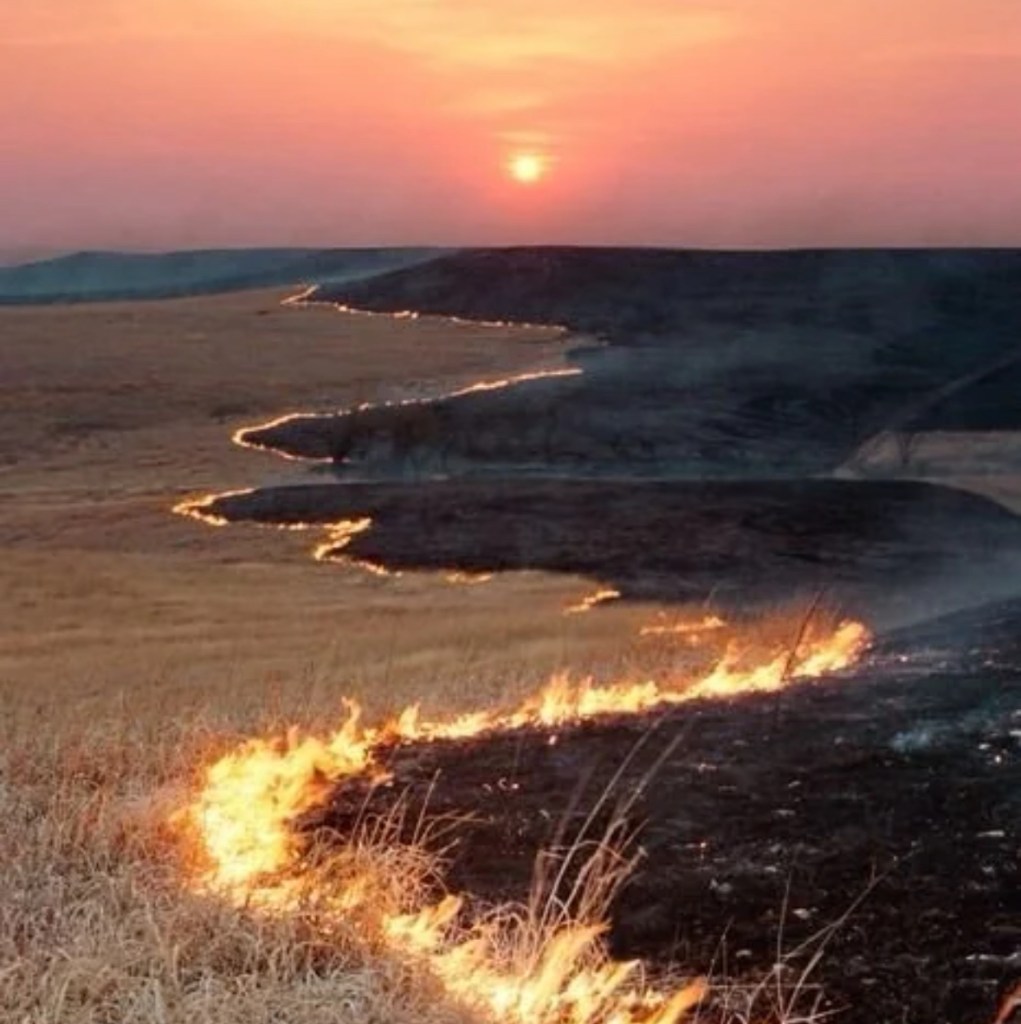
It is suggested that one should wait until wind gusts are less than fifteen miles per hour.
The fertile soil under our boots in the largest natural tallgrass prairie in the United States – The Flint Hills of Kansas – undergoes a replenishment every few years. Occurring when dead prairie tallgrass – dead tallgrass which has accumulated, and now lays dormant – is burned off. Right before Spring arrives.
The ignition of acres upon acres of tallgrasses culminates in quite the scene. Nighttime walls of fire, cascading the prairie’s landscape. Ablaze. Reaching up to twenty feet in height. It’s quite the site to see.
For those driving as the prairie burns, expect to encounter thick smoke. Christened with ash.
Strong winds create a dangerous situation while a prairie burns. Fires are erratic. Winds blowing in excess of 30 mph, coupled to low humidity, could lead to unintended consequences. Such as, a “firenado.” Hence, wise planning. As coordinating burning off dead prairie grasses with tame wind gusts is necessary. “Tame” meaning, wind gusts which max out at less than fifteen miles per hour.
Ranchers patroling fence lines so as to ensure that flames don’t cross over into their pasteurs. Just one of many nuances which come, hand in hand, with Springtime in The Flint Hills of Kansas.
Unplowed slopes of rolling hills. Beset by shallow rocky soil. You may see bison, off in the distance. Topography of TheFlint Hills. Anchored through erosion-resistant limestone.
Tallgrass prairie of the Flint Hills today covers roughly four million acres. With the majority of those nearly-four million acres, found in Kansas. Making The Flint Hills the largest remaining tall grass prairie in the United States.
At one time, tallgrass prairie blanketed 170 million acres of the country. Once extending from the tallgrass prairie’s home today in Kansas – and, to a lesser extent, in Oklahoma – over into Nebraska, Texas, Iowa, Missouri, South Dakota, North Dakota, Illinois. And parts of Canada.
Burning of Flint Hills grasses precedes the planting season each year in Kansas. Taking place in late March. Or early April.
The primary purpose for the annual igniting of the prairie is to enrich the soil. While so too, preventing the encroachment of trees.
Fire-adaptive grasses thrive in The Flint Hills. These grasses, fortified by nutrients which are absorbed by the soil. This absorption of nutrients by the soil is one byproduct of the igniting of the prairie during the Spring.
The prairie is burned. Trees don’t thrive. Nutrient-rich grasses do. Therein lies the point.
Those fires we see in the Flint Hills each Spring eliminate dead grasses. Ridding the prairie of dead grasses – barren of nutritional value – facilitates rapid growth of nutrient-rich grasses. High in protein. A high-protein diet is required in the cattle business.
Switchgrass…
Golden in the Fall, with a greenish-blue color in the Spring. The optimal grazing height of switchgrass is one-and-a-half feet to two feet. In the summer, as traditional grasses stop producing, Flint Hills switchgrass remains rich in protein. Perfect for cattle.
The cattle-to-person ratio in Kansas is two-to-one. Two head of cattle, one person. Cattle is a stalwart in the Kansas economy. There are, give or take, six million head of cattle in Kansas. Needless to say, the cattle industry is firmly entrenched in the economy of Kansas. Contributing $10 billion each year to the State’s GDP.
One secret to the success of Kansas beef would be, weight gains. I.e.: rapid putting on of pounds, which Kansas cattle are able to do. Thanks in large part to rich grasses found throughout The Flint Hills. Those nutrient-rich grasses in Kansas, making up the lion’s share of the diet for cattle.
In Kansas, cattle add most of their pounds, beginning in April – which coincides with the burning of the tallgrass prairie – running through July.
Cattle’s gains…
Kansas cattle can put on up to four pounds of weight – each day – within that April-to-July window. This rapid bulking up by cattle – fueled by nutrients found in Flint Hills tallgrass – contributes to an interest held by out of state ranchers of shipping their cattle to the Sunflower State.
Mature Kansas beef bulls can clock in at between 2,000 to 2,400 pounds. Mature bulls consume up to 45 pounds of dry matter (nutrient content without water) everyday. Possessing such appetites, 4,000 acres of unobstructed nutrient-rich tall grass presents a very nice resource. For ranchers.
With a bull’s substantial daily consumption requirements, cattle from as far away as Florida often make their way up to Kansas’ Flint Hills.. Those nutrient-rich grasses? Attractive to ranchers. Even ranchers beefing up cattle as far away as the Sunshine State.
 Thinking About Becoming a Real Estate Developer?