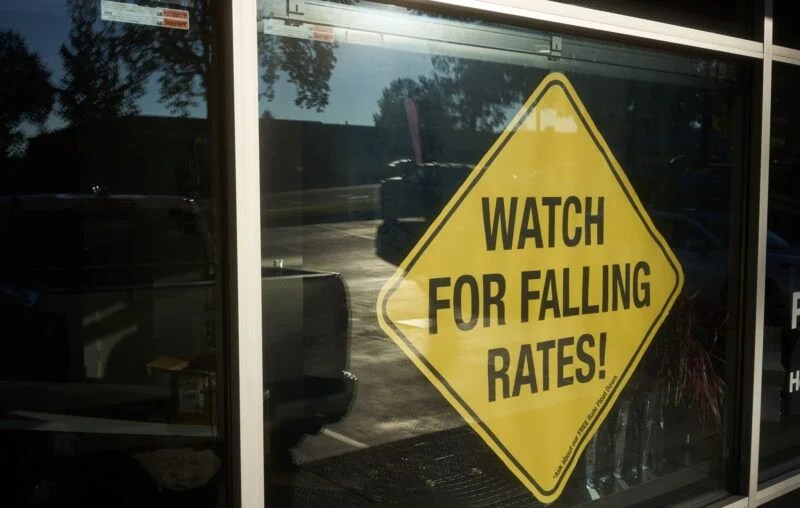
Markets do not optimally function when interest rates are too low. Markets do not optimally function when interest rates are too high. The housing market – as well as the home loan market – would be two markets where this point can be most easily seen.
Artificially-low interest rates create an overly-accommodative economy. The consequences for which we see in today’s stubbornly non-ignited housing market. Mortgage rates are not high today. They’re just a lot high-er than they were during the Pandemic. But mortgage rates today are certainly not anywhere near what we should classify as, high.
The ’70s’ would be one example we could use to illustrate how markets malfunction when interest rates are, first, too low, then, later, increased. Increased too much. Too fast.
There were points in time during the 1970’s where the country was actually in a negative interest rate environment. Bank deposits were yielding “storage charges,” so you speak. As opposed to throwing off interest income.
The low-rate environment in the 1970’s came about in many ways because the stock market was in shambles. The result of that market unease of the ‘70’s? The Fed enacted an easy money policy. The idea at the time being, to attain full employment. Overly-accommodative. This was a flawed approach. Which became highly inflationary.
Enter price controls? Yep. Did you ever make one mistake, then double-down, only make to make your second mistake? In succession? An easy money policy followed by price controls? That ill-advised combination did not work out so well.
So by the late ’70’s, with the country in the midst of rampant inflation, the Fed began to ratchet up interest rates. To temper the inflation. The origin of this inflation which was now being battled was of course triggered by the overly-accommodative fiscal policy of the Fed years before. The result of moving from an accommodative fiscal policy to a restrictive fiscal policy by way of rising interest rates? The economy went into recession.
Let’s look at another recent timeframe…
In the early-2000’s, interest rates were lowered. Interest rates became accommodative. At that time, lower interest rates were married to accommodative home loan underwriting policies. The result? Skyrocketing home values. An increase in home loan defaults. The Financial Crisis.
Overly-accommodative policy = a rough landing.
Overly-restrictive policy = a rough landing.
Overly-accommodative policy followed by overly-restrictive policy = a rough landing.
During the Pandemic, the federal funds rate was lowered to a range of 0% to 0.25%. Mortgage rates dropped. Home prices went up.
Fast forward to 2025…
Today, more than 75% of homeowners are nestled cozily in with a sub-5% mortgage rate. Around 55% of homeowners are nestled cozily in with a sub-4% mortgage rate. This “lock-in effect” we have in housing in 2025 is one byproduct of the low-rate policy the Fed enacted during the Pandemic.
Last year 25 out of every 1,000 homes found their way to new buyers. That was the lowest turnover rate we saw in housing in 30 years.
Accommodative policy – I.e.: low interest rates – do not only lead to future restrictive policy by way of elevated interest rates. Accommodative policy leads to the market restricting itself. Which is exactly where we are right now.
For example…
Why sell your home when the interest rate you have on your mortgage is 4% or less? Especially when you know you’d have to go out and buy another home in the midst of a restrictive cycle – at an elevated price, no less – with a mortgage rate which would be between 6% and 7%?
Prior to the U.S. government’s entrance into the home loan business in the 1930’s – this coming as a result of FDR’s New Deal – savings and loan associations had, up until that point, provided the majority of the loans which were used to finance the acquisition of homes.
The Homeowners Refinancing Act and the Home Owners Loan Corporation Act were each passed in 1933…just as the Great Depression was devastating the finances of Americans. These two housing Acts? Extensions by the U.S. government into the private sector. One byproduct of FDR’s New Deal.
The Home Refinancing Act and the Home Owners Loan Corporation Act provided assistance to Americans who were in danger of losing their homes. Due to an inability to refinance their home loans. Thanks to the New Deal, Americans gained access to new refinancing opportunities. Which, should there have been no New Deal, would not have been in place. The government’s election to get more deeply involved in the home loan business during the Great Depression was a wise foray by the U.S. government into the private sector.
Rewind to 300 years before the New Deal. Rewind to the earliest days of settlers moving west into new territories of what would in time become the United States.
Whereas FDR’s New Deal took aim at stabilizing a teetering U.S. housing market during the Great Depression, for early settlers, there wasn’t a need for government assistance in regard to real estate. There were no government programs in place to assist early settlers. There was no U.S. government to provide such government assistance.
During the 17th Century, there were no American institutional resources – nor government programs – which could facilitate real estate transactions. Was there interest during the 17th Century in acquiring land? Yes. Was there a banking industry? Was there a mortgage industry? Were there government programs in place which could be relied upon to help finance real estate transactions? No. No. And…no.
During the 17th Century, land acquired by settlers who moved west…those land acquisitions would not be categorized as real estate sales. Nor was acquired land financed through the use of mortgages. No, in the 17th Century, those who aspired to own their own land in this vast, new territory ventured out west. They found a piece of land. They claimed the land. Land ownership without a deed. Without a mortgage. Without government oversight.
At that time, there was not a lot of “demand” for this land. Though the natives who long inhabited this land, pre-settlement, would beg to differ. There was no formal market established, through which land could be bought and sold. Nobody was entering into real estate contracts when they acquired their land. No sellers, as we would categorize sellers today. No buyers, as we would categorize buyers today.
Land acquisition – by way of financing the land acquired – was not the practice. Claiming unsettled land was the practice. No real estate contracts. No mortgages. No deeds. Interesting how, 300 years later, the U.S. government’s role in the home loan business would become so pronounced. So important. Interesting how the U.S. government evolved into a stakeholder in the business of financing real estate. This role for government occurred, largely, through FDR’s New Deal.
Government’s intervention in the home loan business? That was during the 1930’s. Government’s complete absence from the process of acquiring land? That would have been during the aforementioned 17th Century. How about vehicles used to finance the purchase of real estate, relevant to protections found within FDR’s New Deal? That would be banks.
Six years after Henry Duncan established the first savings bank in England in 1810, the first saving bank was organized in the United States. In Philadelphia. That bank was the Philadelphia Saving Fund Society – the very first American savings bank.
Philadelphia Saving Fund Society opened in Philadelphia in 1816…established by a group of investors headed by War of 1812 veteran – and Philadelphia native – Condy Raquet.
Bank takeovers, bank mergers, bank acquisitions… What once had been the Philadelphia Saving Fund Society is now part of Citizens Bank of Pennsylvania.
Whereas Philadelphia is home to the first American savings bank, Philadelphia is also home to the first commercial bank established in the United States.
Thirty-four years prior to the establishment of America’s first savings bank – Philadelphia Saving Fund Society, formed in 1816 – we have the first United States commercial bank. Also founded in Philadelphia. That year would be 1781. The bank? That bank was Bank of North America.
Bank of North America was the first chartered bank – the first commercial bank – organized in the United States. Bank of North America…the formation for which emanated from an idea shared by two early American forefathers. Those two forefathers? Alexander Hamilton and Henry Morris.
Hamilton and Morris set up their bank to function as an informal American central bank. Their idea for the bank being, to provide financing to the United States government. Though constructed with the goal for their bank to operate as a de-facto, unofficial United States central bank, Bank of North America instead became a traditional state chartered bank. Not the central bank it was envisioned to become. Bank of North America was never the government financing tool Hamilton and Morris envisioned the bank to be. Rather, Bank of North America provided home loans to Philadelphians.
Bank takeovers, bank mergers, bank acquisitions… Bank of North America is now part of Wells Fargo.
During the 1800’s, loans used by Americans to finance real estate were not mirror images of the loans Americans use to finance homes in 2024.
During the 19th Century, home loan payment schedules were much shorter. No 30-year amortization. No 15-year amortization. Rather, in the 19th Century, you’d likely have either a 5-year or a 6-year loan payment schedule. No 15-year amortization. No 30-year amortization.
During the 19th Century, balloon mortgages were common. With a 5-year mortgage or a 6-year mortgage, qualifying for the home loan was difficult. And, in many cases, those 5-year or 6-year mortgages were balloon mortgages.
19th Century balloon mortgages were often structured with interest-only payments. After the mortgagor made their payments for the five or six years, the loan would then “balloon.” Whereby, the mortgagor would at that time be required to pay off their loan in full.
Coupled to interest-only payments – with the balloon provision – 19th Century mortgages would oftentimes be accompanied by low loan-to-values. In the range of a 50% loan-to-value. With interest-only payments made for 5 or 6 years, loan payoffs for mortgagors after the 5 or 6 years would have remained at payoff amounts equal to 50% of the purchase price of the property. Not taking into account any potential property appreciation. No New Deal. No government assistance available. Difficult to pay off and/or refinance home loans at that time…
In the midst of the Great Depression, upwards of 40% of all home mortgages in the United States were in default. Hence, FDR’s New Deal…
No government regulation for those early land acquisitions out west. No government regulation when those home loans were interest-only, coupled to balloon provisions. Rationale behind some form of a “new deal”…maybe?
Through the FHA, longer loan terms became available. 20-year mortgages. 30-year mortgages. Amortized. Unlike earlier interest-only mortgages, through FDR’s government reach into the real estate sector, mortgagors would be paying down their home loan principal balances. Through each and every payment they made.
The 1934 National Housing Act was signed into law by President Franklin Delano Roosevelt on June 27, 1934. The 1934 National Housing Act fundamentally changed government’s role in housing.
The United States Housing Act of 1937 – the Wagner-Steagall Housing Act – established the Federal Housing Administration (the FHA). The FHA was created to handle mortgage insurance. Mortgage insurance allowed for amortized mortgages…coupled to regular monthly payments.
Mortgage rates are at their highest levels in two months. This, after the Federal Reserve cut the federal funds rate for the first time in four years.
The Federal Open Market Committee sets a target range for the federal funds rate. The federal funds rate? The federal funds rate is the interest rate banks pay on money they – as banks – borrow from other banks.
The Fed does not directly set mortgage rates.
The Fed influences mortgage rates. The Fed influences mortgage rates through the role the Fed plays in setting monetary policy. As such, the Fed indirectly affects the interest rates borrowers lock into at the consumer level, by way of how credit spreads evolve in the market as a result of the Fed’s actions. In relation to the issuance of debt instruments.
Credit spreads consist of the purchases of – and then the simultaneous sales of – contracts within the same asset classes. Credit spreads are not always so easy to predict. Then too, mortgage rates are not necessarily – nor definitively – so easy to predict, short term, either. Although the general direction mortgage rates will end up heading can rather accurately be predicted through actions taken by the Fed.
When mortgage rates are high – like they are today – you can use a 2-1 interest rate buydown to obtain a lower mortgage rate. And a lower mortgage payment.
The 2-1 interest rate buydown is a home loan feature whereby funds are set aside in an escrow account at the closing. These funds are set aside for the benefit of the buyer. The escrowed funds enable the buyer to “buy down” their interest rate for the first two years. In year one, the buyer’s interest rate will be 2% lower than the 30-year rate. In year two, the buyer’s interest rate will be 1% lower than the 30-year rate.
The 2-1 interest rate buydown is simple. It’s a 2% interest rate reduction in year one. It’s a 1% interest rate reduction in year two.
In years 3 through 30, the buyer’s interest rate remains the same. The buyer’s mortgage payment will remain the same as well. The buyer’s interest rate in years 3 through 30 – as well as the buyer’s mortgage payment in years 3 through 30 – is established when the buyer locks their rate.
The 2-1 interest rate buydown provides a buyer with an opportunity to qualify for a larger loan amount. This increases the number of homes the buyer can go out and look at.
By using the 2-1 interest rate buydown, a buyer can purchase a larger home. A buyer can purchase a more expensive home. A buyer can purchase a home with more “bells and whistles.” All are nice options. Possible, through the use of the 2-1 interest rate buydown.
What does a 2-1 interest rate buydown cost?
The cost of the 2-1 interest rate buydown is equal to the difference between principal and interest payments – based on the 30-year rate, which goes into effect in year 3 – and the principal and interest payments on the bought-down, lower rate in year 1 and year 2. Escrowed buydown funds are paid at the closing. Paid by the seller. Held in escrow. For the benefit of the buyer.
You are thinking about selling your home. How can the 2-1 interest rate buydown help you, as the seller? Let’s look at a few situations…
When the housing market is softening. When higher numbers of sellers are listing their homes for sale. When the housing market shifts from a seller’s market to a buyer’s market. When you see price reductions. When homes are sitting on the market – unsold – for longer periods of time. In each situation, the 2-1 interest rate buydown is an attractive tool that can be used by a seller to attract more buyers.
Over the past few years, mortgage rates have remained stubbornly high. When mortgage rates are high – like they are today – buyers who may be thinking about purchasing a home are also thinking about those higher mortgage rates. Higher mortgage rates = higher mortgage payments.
The 2-1 interest rate buydown lets a buyer get into the home they want today, with an interest rate during the first two years that will be closer to the lower mortgage rates buyers were used to seeing a few years ago. Lower mortgage rates buyers are eagerly waiting for. Mortgage rates…that are just not getting much lower.
Families hoping to purchase a home are taking notice of higher mortgage rates. Higher mortgage rates place pressure upon family budgets. This affects whether a buyer will decide to submit an offer to purchase a home. Which in turn, affects prices sellers get for homes they are selling. All being good reasons to consider using the 2-1 interest rate buydown. The 2-1 interest rate buydown benefits buyers. The 2-1 interest rate buydown benefits sellers.
Through the 2-1 interest rate buydown, as the seller, you offer your buyers the benefit of the lower mortgage rate. And the lower mortgage payment too. In year one. And in year two.
As the seller, by offering your buyers a lower mortgage rate for the first two years, you will attract more buyers to your home. Because your home is being sold with the 2-1 interest rate buydown. Because your home is being sold with a lower mortgage rate. Because your home is being sold with a lower mortgage payment. For two years. As the seller, this positions your home – which is being presented to buyers, with the 2-1 interest rate buydown – as an attractive option. Especially when compared to other homes on the market that buyers may be looking at. Because those homes don’t provide buyers with a lower mortgage rate in year 1 and year 2. Because those homes don’t provide buyers with a lower mortgage payment in year 1 and year 2. And yours does!
The 2-1 interest rate buydown. It’s great for sellers. The 2-1 interest rate buydown. It’s great for buyers.
Over the past few years, yields on 10-year Treasuries rose. So too did mortgage rates. Those higher yields…benefitting investors who purchased Treasury bonds. By way of higher earned interest income. Yet these higher bond yields functioned as a “tax” on home buyers. Driving up the cost of homeownership. Due to higher mortgage rates. Due to higher monthly mortgage payments. Arguably, having the same effect as a “consumer tax” placed upon homeownership.
Remember, during this recent environment of increased – and increasing – bond yields, coupled to elevated mortgage rates, home prices rose. Home prices did not go down. Housing inflation got worse: 1) higher home prices, and 2) higher interest rates.
As monthly mortgage payments rose for home buyers as a result of higher mortgage rates (coupled to increasing home prices), what simultaneously so too did rise were earned income opportunities for bondholders. Bondholders benefitted…at the expense of home buyers.
If the Fed does indeed enact two rate cuts through the end of 2024, mortgage rates are likely to drop. As too will yields bondholders attain, through their purchase of newly-issued 10-year Treasuries.
A trade-off is in the making. A much-welcomed rebalancing.
When there is an elevated level of demand for 10-year Treasury notes, investor bids for the notes would most likely come in at or above a bond’s face value. These higher offer prices for bonds drive bond yields down. This is so due to investors’ willingness to accept lower coupon rates for bonds in exchange for the de-facto loans they are making to the United States government by way of their purchase of 10-year Treasuries.
When investors determine that there is market volatility, investors may be inclined to accept lower yields on their “loans” to the United States government. An investor’s determination of a “volatile” market could lead the investor to arrive at their conclusion that government bonds are a safe place to park their money, as compared to other available investment vehicles they have available to select from (i.e.: the stock market).



 Thinking About Becoming a Real Estate Developer?