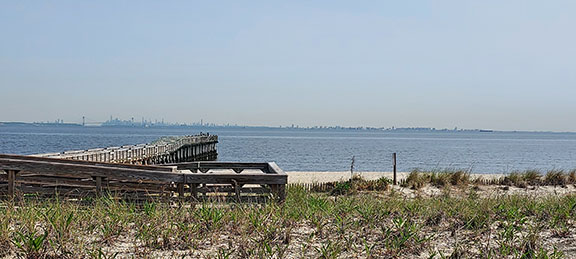
Port Monmouth, Shoal Harbor and Raritan Bay…
Resting on Sandy Hook Bay, along the New Jersey coastline next to the Raritan Bayshore we find Port Monmouth. And Shoal Harbor.
Port Monmouth looks directly out across Raritan Bayshore. Raritan Bayshore is an extension of Raritan Bay.
With its coastal position on Raritan Bay, one may surmise that evolution for Port Monmouth would have been shaped by Port Monmouth’s location. Located forty miles or so across the Raritan Bay from New York City. And that summation would be accurate.
Today’s Port Monmouth is the end result of yesterday’s improvements made in methods of transportation. Primarily, methods of transportation established to facilitate maritime traffic going from Monmouth County to New York City.
With its position on the coast of Raritan Bay, in order to benefit from improved maritime transport, Port Monmouth would first need a pier.
That first Port Monmouth pier was constructed in 1853. That first Port Monmouth pier was constructed at the end of, what today, would be Church Street. And that first Port Monmouth pier constructed off Church Street over one-hundred fifty years ago needed to extend far enough out into Raritan Bay to enable boats to dock at Port Monmouth. And not run aground.
The company which built that first Port Monmouth pier was Port Monmouth Steamboat and Sloop Transportation Company.
A budding commercial enterprise, Port Monmouth Steamboat and Sloop Transportation Company curried freight – as well as passengers – from Port Monmouth into New York. The company first identified, then built out, their maritime niche.
With their pier built, Port Monmouth Steamboat and Sloop Transportation Company proceed to develop this area located the end of Church Street to accommodate passengers.
The company built a hotel at the end of their Church Street pier. The company also built a pavilion.
Port Monmouth Steamboat and Sloop Transportation Company created a resort-of-sorts at the end of Church Street. Maritime passengers could now enjoy their wait on the bay, prior to boarding a steamboat heading into Manhattan.
One year after that first pier in Port Monmouth was built at the end of Church Street, opportunities emanating from newfound transportation and commerce possibilities – as Port Monmouth was now connected to New York City – would come to be enhanced.
In 1854 Port Monmouth and Middletown Plank Road Company made their contribution to Port Monmouth commerce.
In 1854 Port Monmouth and Middletown Plank Road Company built an important timber plank road in Port Monmouth.
“The Farmer’s Railway.”
A timber plank road is a roadway built by laying wooden planks, side-by-side. For timber plank roads, those wooden planks are laid across beams. Those beams used to construct a timber plank road were called stringers. Once laid, stringers were stable. Held in place, not by nails. Rather, stringers were held in place by the weight of the stringers. Stringers were heavy.
The addition of a timber plank road to Port Monmouth enabled local farmers to bring their goods to market.
During the Nineteenth Century timber plank roads were known as farmers’ railroads. Whereas, in the Nineteenth Century, farmers were faced with the daunting task of transporting their goods to market over terrain which was rugged, difficult and rough, a smooth timber plank road changed that problem. A timber plank road made a farmer’s path to the market much, much easier.
That timber plank road built by Port Monmouth and Middletown Plank Road Company in Port Monmouth created the opportunity farmers needed in order to get their produce over to the pier.
That timber plank road built in Port Monmouth also enabled farmers to bring their produce to the local market in Middletown.
In Middletown, farmers sold their produce. That timber plank road built in Port Monmouth connected Port Monmouth to Leonardville Road. Landing a farmer in Middletown.
Going back to the role Port Monmouth Steamboat and Sloop Transportation Company played in Port Monmouth’s development, the northernmost point of that timber plank road was the pier built by Port Monmouth Steamboat and Sloop Transportation Company. At the end of Church Street.
Farmers had a new and improved pathway to the market. Thanks to that timber plank road built in Port Monmouth, farmers could reach Middletown.
While also accessing a much larger market too. In New York City. By ship.
Buyers of produce in New York were now accessible to farmers because, first, a pier was built. Then, second, a road was built.
The early days for Port Monmouth’s economy…
We have the pier.
We have “The Farmer’s Railway.”
So what came next in the chronology of Port Monmouth’s development?
What came next for Port Monmouth was the railroad.
In 1854 Raritan and Delaware Bay Railroad Company was organized. The mandate for Raritan and Delaware Bay Railroad Company was to build a railroad which would connect the Raritan Bay to the Delaware Bay.
Construction of that railroad – linking the Raritan Bay to the Delaware Bay – began in 1856. Four years later, trains were en route, from bay to bay.
By late in the Nineteenth Century, in Port Monmouth, steamboats were transporting farmers’ produce, freight and passengers into New York City.
By late in the Nineteenth Century, in Port Monmouth, farmers benefitted from the “farmer’s railway.” Making a farmer’s trip to the Church Street pier and to Middletown easier.
By late in the Nineteenth Century, rail connected Port Monmouth’s bay – the Raritan Bay – to the Delaware Bay.
Steamboats, roads and rail. The table had been nicely set for this settlement along Raritan Bayshore to mature, to evolve and to grow.
The beginning days for Port Monmouth.
Your questions and your comments about my Port Monmouth piece are always welcome. If you’d like, please feel free to contact the autor, Ted Ihde, by phone or by email.
Direct: 816-699-6804
Email: authortedihde@gmail.com


