In the late 1860’s, a young Illinois cattle dealer – Joseph “Cowboy” McCoy – had been scouting out locations. Cowboy McCoy was interested in an area along what became the Kansas Pacific rail line.
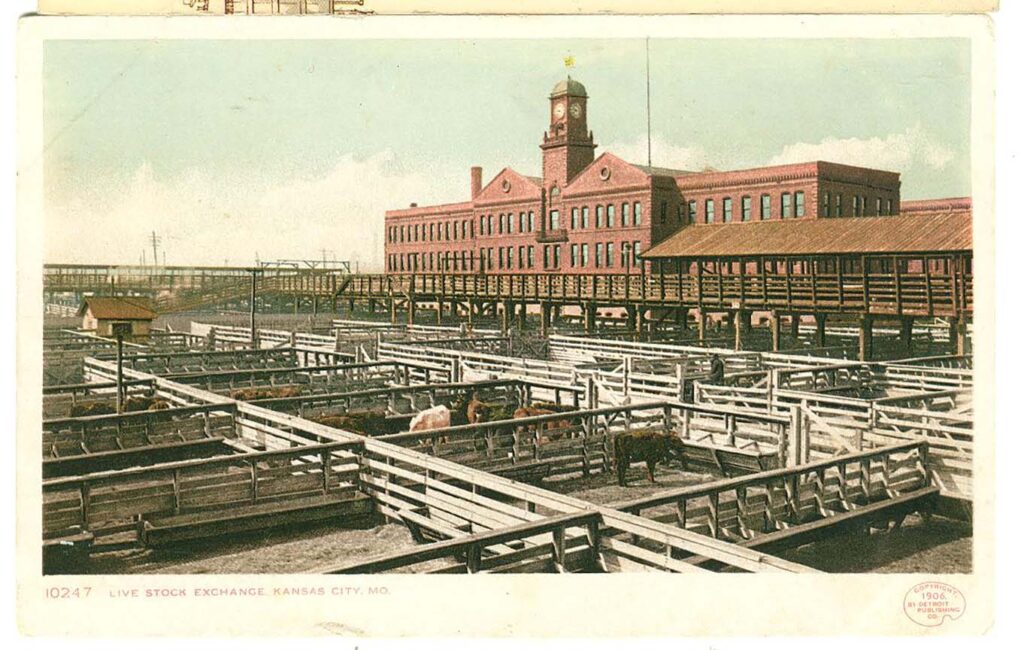
Cowboy McCoy was looking for the ideal setting. A destination point. Someplace Texas cattlemen could drive their cattle up north to before being sent on to Abilene, Kansas.
From Abilene, cattle would be shipped east. To Kansas City. Therein lies the origin for Kansas City’s emergence in the early Twentieth Century American cattle business.
A few years after Cowboy McCoy settled in Abilene, Kansas City got their stockyards. Kansas City’s stockyards were located in a section of KC known as the West Bottoms. The birth of KC’s stockyards? 1871.
One: Cowboy McCoy. Two: Abilene. Three: The cattle business and Kansas City. Further writing, focused upon the latter. The two formers…mentioned as historical occurrences, relevant to the latter…
Ten years prior to KC getting their stockyards, Kansas City’s population had been about 4,000. By 1900, KC’s population grew to 160,000. Kansas City’s cattle industry was the driving force behind the city’s population growth.
Kansas City’s stockyards enabled livestock owners to transport their cattle to an exchange. At this newly-formed exchange in Kansas City, cattle could be sold to the highest bidders. Prior to the establishment of KC’s stockyards – and the exchange – livestock owners were only able to sell their cattle at whatever price railroad men offered to pay…limiting earning potential for cattle men. Kansas City’s stockyards – coupled to the establishment of the Kansas City Livestock Exchange – created a market for cattle men. The result? Higher cattle prices.
The Kansas City Livestock Exchange Building was constructed in 1911. At that time, the Kansas City Livestock Exchange Building was the largest livestock exchange building in the world.
The Exchange Building in Kansas City once housed over 400 offices. Telegraph offices. Beauty shops. Cattle tradesmen. Packing house buyers. Banks. All could be found in the Exchange Building in KC early in the 20th Century.
If you strolled through Kansas City’s stockyards early in the 20th Century, you could have found yourself in either Kansas or Missouri. The stockyards straddled both states.
KC’s stockyards were established in Kansas. Along the Kansas River. Two-thirds of KC’s stockyards were located in Kansas. The remainder of KC’s stockyards were located in Missouri.
By 1914, KC’s stockyards consisted of over 200 acres. Sixteen railroads converged in KC’s stockyards. The growth of the KC cattle trade – as well as the growth of the railroad – significantly contributed KC’s population growth. And to the growth of Kansas City’s economy. Kansas City’s first Union Station opened in the stockyards. In 1878.
By 1923, over 2.5 million head of cattle were shipped through KC’s stockyards. Local Kansas City packing houses were purchasing over 1 million heads of cattle per year. Only Chicago – Chicago’s Union Stockyards – was processing more cattle than KC. In fact, a world record was set in those KC Stockyards. In 1923. The record? One day’s receipts of cattle: 60,206 head
The maximum daily capacity of KC’s stockyards grew to nearly 200,000 head of cattle. Creating thousands of jobs. The KC stockyards were taking in cattle from 35 states. Shipping cattle off to 42 states. Plus Canada. Hence, Kansas City’s nickname – Cowtown.
In KC’s West Bottoms, where the stockyards were once located, where the cattle industry once thrived, today, you won’t find any cows.
Today in the West Bottoms, Flaherty and Collins’ Stockyards Place is a beautiful 21st Century Midwest collection of condominiums. Luxury living. A trendy urban lifestyle. A bike trail which runs alongside the Kansas River. No cows.
KC’s stockyards processed their last head of cattle in 1991. In October of 1991, KC’s stockyards were closed for good. No more packing house buyers.
Today, a different form of buyers can be found where the KC stockyards once were. This new form of buyers? They’re Kansas City professionals. KC professionals who are shopping for a new condo. Buyers? Yes. Packing house buyers? No.
The Livestock Exchange in Kansas City was located on Gennessee Street. Just a stone’s throw away from that old exchange on Gennessee Street, today you’ll find Stockyards Place. Luxury living. Walking distance to wineries. To galleries. No cattle pens. No feedlots. No cows.

 Thinking About Becoming a Real Estate Developer?